
INDIA 2030: Global by Design.Indian at Core
There are defining moments in a nation’s industrial journey when momentum transforms into strategic direction. India’s construction sector has reached that threshold. Across corridors, coastlines and city skylines, the country is not simply expanding capacity — it is strengthening exacting and expectations unmistakably higher. Machines are becoming smarter. Manufacturing is gaining depth. Standards are steadily rising. The ambition is no longer confined to domestic scale; it carries global intent. What distinguishes this phase is alignment. Policy continuity, sustained capital investment, manufacturing expansion and technology integration are converging with rare clarity. Infrastructure is no longer a catch-up imperative — it is a competitive instrument. As Construction Opportunities marks eleven years of chronicling this transformation, we turn to the decade ahead — one in which India’s construction ecosystem positions itself not just as a market of scale, but as a benchmark of execution. Global by design. Indian at core….. writes, PRERNA SHARMA.
Every decade has a defining shift. For India, the years leading to 2030 mark the transition from infrastructure expansion to infrastructure leadership. For nearly two decades, the country’s construction narrative was defined by catching up — bridging deficits in highways, ports, power, rail and urban mobility. Today, that narrative has changed. India is no longer building to close gaps. It is building to compete, to integrate with global supply chains, and to position itself as a design-driven, manufacturing-backed construction powerhouse. The difference is visible in the ambition of planning, the discipline of execution and the depth of capital commitment. Infrastructure creation is now embedded into the economic architecture of the nation. It is directly linked to manufacturing growth, export competitiveness, logistics efficiency and energy transition. The construction sector is no longer peripheral to GDP expansion — it is central to it.
What makes this moment an inflection point is the shift from volume to velocity, and from velocity to intelligence. Planning is increasingly corridor-based rather than project-based. Logistics integration is being digitally mapped through frameworks such as PM Gati Shakti. The long-term pipeline visibility under National Infrastructure Pipeline has reduced uncertainty and improved capital alignment. This systemic approach signals maturity. Infrastructure is no longer reactive — it is strategic.
The Union Budget 2026–27 reinforces this trajectory not as a starting point but as a stabilising force. Public capital expenditure has nearly doubled over the past five years — rising from roughly `5.5 lakh crore to levels consistently above `10 lakh crore — and continues to prioritise transport corridors, rail modernisation, logistics connectivity and urban infrastructure. The significance lies less in incremental increases and more in continuity. The Budget reflects growing fiscal discipline, combining sustained public investment with asset monetisation mechanisms, expanding public-private participation and long-term funding instruments such as infrastructure and green bonds. Infrastructure spending is therefore shifting from cyclical stimulus to structural baseline, providing the policy predictability required for manufacturers, contractors and investors to commit capital with greater confidence. As India moves through 2025 and into 2026, execution momentum has become measurable. Highway construction intensity remains robust. Rail infrastructure is being modernised at unprecedented speed. Port capacity and hinterland connectivity are expanding in sync. Urban transit systems are spreading deeper into Tier-2 cities. This is no longer sporadic growth; it is coordinated acceleration.
At the same time, the quality threshold is rising. Engineering standards are tightening. Safety benchmarks are strengthening. Digital project monitoring and data-led decision frameworks are reducing delays and enhancing transparency. India’s infrastructure build-out is increasingly aligned with global technical norms — while retaining the cost efficiency and adaptability that define its domestic advantage.
By 2030, the success of this phase will not be measured solely in kilometres of roads or megawatts installed. It will be measured in logistics efficiency gains, manufacturing competitiveness, export readiness and sustainability integration. The coming years will determine whether India merely expands infrastructure capacity — or transforms it into a globally benchmarked ecosystem.
This is the essence of the inflection. India is no longer building just to serve its domestic demand. It is building with global alignment in mind — design sophistication, execution discipline, manufacturing integration and sustainability foresight. That convergence is what positions 2030 not as a distant milestone, but as a strategic destination.
Landmark Projects Redefining the National Landscape
If the first half of this decade established intent, the projects underway across India in 2025 and 2026 demonstrate execution at scale. The country’s infrastructure landscape is being reshaped by assets that are not only larger in size, but more complex in engineering, financing and integration than ever before. These are not incremental upgrades — they are structural anchors for the 2030 vision.
Across geographies, a series of engineering landmarks has reinforced India’s ability to execute globally significant infrastructure in challenging terrain. The commissioning impact of the Atal Tunnel beneath the Rohtang Pass continues to redefine all-weather connectivity in the Himalayas, demonstrating advances in high-altitude tunnelling, safety architecture and strategic mobility. Complementing this, the Chenab Rail Bridge — the world’s highest railway arch bridge and a critical component of the Udhampur–Srinagar–Baramulla Rail Link — represents engineering precision under extreme conditions while strengthening year-round rail integration of the Kashmir Valley.
Urban-regional connectivity is witnessing similarly visible transformation. The Atal Setu has emerged as one of India’s most consequential marine infrastructure achievements, compressing travel time between Mumbai and Navi Mumbai while reshaping freight flows, port access and connectivity to the upcoming Navi Mumbai International Airport. Such assets are redefining metropolitan logistics geography rather than merely easing commuter movement.
On the highways front, execution under Bharatmala Pariyojana is increasingly defined by access-controlled corridors and urban expressway systems. The operationalisation of large stretches of the Dwarka Expressway illustrates how next-generation road infrastructure is being designed to decongest cities, accelerate peri-urban development and enable faster freight movement. Parallel progress on long-distance corridors such as the Ganga Expressway reflects the scale at which greenfield mobility infrastructure is expanding across emerging economic regions.
Strategic tunnel and mountain corridor infrastructure is emerging as a defining layer of resilience. Projects such as the Zojila Tunnel signal India’s growing capability to deliver year-round connectivity in high-altitude environments, strengthening defence logistics, tourism flows and regional economic integration.
Freight logistics is undergoing a structural shift with the operationalisation and expansion of the Dedicated Freight Corridor. By segregating freight and passenger traffic, the corridor is enhancing rail speeds, reliability and capacity, directly reducing logistics costs for industry and improving supply chain predictability for a manufacturing-led growth strategy.
Port-led development under the Sagarmala Programme is enhancing cargo handling capacity and improving last-mile connectivity. Inland waterways, coastal shipping and logistics parks are increasingly being integrated into a multimodal cargo framework — signalling a shift toward seamless cargo movement rather than isolated infrastructure expansion.
Industrial corridor development, particularly along freight and expressway networks, is accelerating cluster-based manufacturing growth. These corridors are being aligned with renewable energy parks, warehousing ecosystems and data centre clusters, reinforcing infrastructure as an interconnected economic platform.
What unites these landmark projects is not just scale, but synchronisation. Engineering complexity, financial structuring, land acquisition frameworks and digital monitoring mechanisms have evolved significantly. Projects are increasingly tracked in real time, dispute resolution timelines are compressing, and private participation is regaining momentum. The emergence of such engineering achievements signals a shift from infrastructure expansion to infrastructure excellence — where complexity, durability and integration define success. Large capability-building programmes continue in parallel. The Mumbai–Ahmedabad High-Speed Rail Corridor, while still under development, symbolises India’s long-term technological leap in rail mobility. Beyond speed, it is catalysing domestic capability in high-precision civil works, advanced track systems and safety architecture — embedding global engineering standards into India’s infrastructure ecosystem.
By 2030, these assets will collectively redefine India’s economic geography. Travel times will compress. Logistics costs will decline. Urban mobility will become more predictable. Industrial production will align more tightly with global supply chains. The visible transformation underway in 2025 and 2026 is therefore not episodic — it is foundational. These landmark projects are the physical expression of India’s global design ambition. In the next section, the focus shifts to the engine powering this transformation: the construction equipment ecosystem that is scaling in parallel with the nation’s infrastructure surge.
The Equipment Multiplier Effect: Powering the Build-Out
If landmark infrastructure projects define India’s ambition, construction equipment defines its execution velocity. The scale of highways, rail corridors, mining clusters, ports and urban redevelopment would not be possible without a parallel surge in mechanisation. Equipment is no longer a background enabler — it is a primary determinant of productivity, safety, quality and timeline compression.
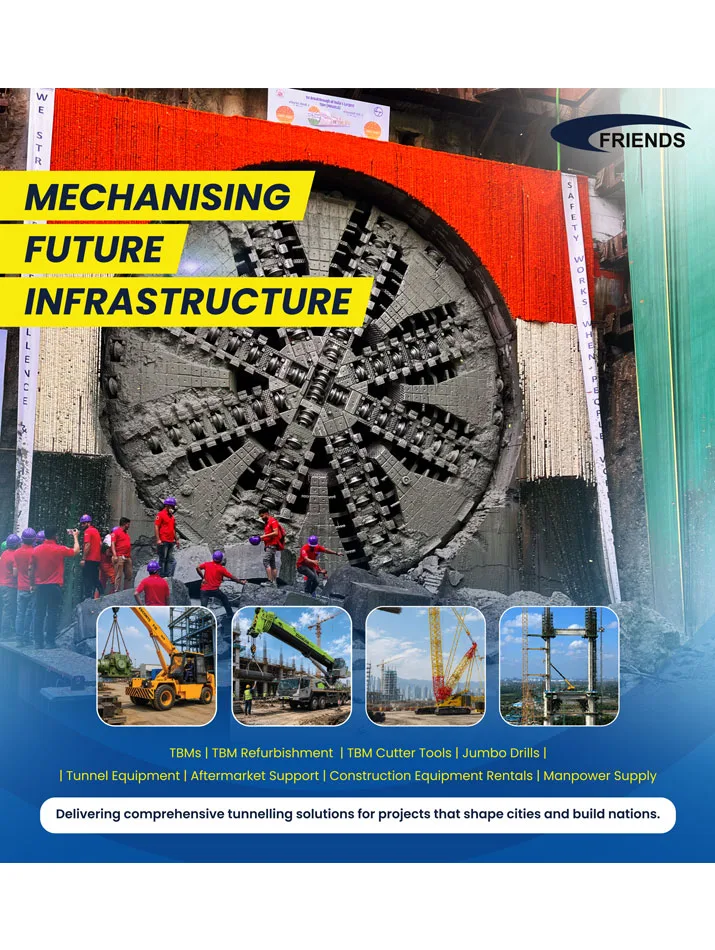
As projects grow larger and more technically demanding, equipment intensity per project has risen sharply. Expressways require high-capacity earthmoving fleets, intelligent compaction and advanced paving systems. Rail and metro projects depend on precision piling rigs, tunnel boring machines and heavy lifting solutions, while ports and marine infrastructure rely on specialised cranes, dredging and material handling equipment. The average project today deploys a broader, more sophisticated equipment mix than a decade ago.
Mechanisation is also penetrating historically labour-intensive segments. Sensor-based grading, automated batching and compact urban equipment are improving accuracy, reducing rework and enabling execution in constrained environments. The industry is shifting from manual optimisation to machine-led precision.
This shift reflects a changing cost calculus. With tighter financing and greater scrutiny of delays, productivity per machine hour has become critical. Equipment is increasingly viewed as a productivity multiplier rather than a capital burden — compressing timelines, improving durability and lowering lifecycle costs. Telematics-enabled fleets, intelligent compactors and high-capacity excavators are directly influencing margins and project viability.
The rental ecosystem is accelerating this transition. Organised rental platforms and fleet aggregation models are enabling contractors to access advanced equipment without heavy upfront investment, widening mechanisation across the value chain and supporting asset-light execution strategies.
Digital integration is further redefining equipment economics. Telematics, predictive maintenance and performance analytics are becoming standard, allowing fleet owners to monitor utilisation, reduce downtime and optimise fuel efficiency. OEM relationships are evolving toward lifecycle partnerships built around service, data and performance outcomes.
Safety and sustainability are also reshaping deployment decisions. Emission-compliant engines, improved operator ergonomics and advanced safety systems are increasingly prerequisites for large infrastructure bids, linking equipment choice directly to competitiveness.
By 2030, infrastructure capability will be measured not only by assets created but by the efficiency of delivery. The multiplier effect of modern equipment — higher output, lower fuel consumption and improved lifecycle performance — will determine whether India meets its execution targets within financial discipline.
The construction equipment sector is therefore not passively riding the infrastructure wave. Mechanisation depth, digital intelligence and fleet optimisation are enabling India to build faster, smarter and at global benchmarks. Equipment has moved from a support function to the strategic engine of the build-out.
Made in India, Built for the World
India’s construction equipment landscape in 2025–26 is increasingly being shaped by domestic manufacturing strength and the evolving needs of regional contractors executing the country’s infrastructure build-out. The narrative has moved beyond localisation toward capacity expansion, product innovation and the ability of Indian facilities to serve both national demand and export markets operating under similar cost and utilisation pressures.
Global OEM investments continue to underpin this growth. JCB has expanded manufacturing across Ballabgarh, Pune and Jaipur through automation, robotic fabrication and capacity upgrades, enabling India-engineered launches across backhoe loaders, specialised long-reach excavators and higher-tonnage machines. These platforms — equipped with telematics, improved hydraulics and multi-emission configurations — are increasingly designed for contractors managing high-intensity project cycles.
Caterpillar Inc. has reinforced its Indian manufacturing ecosystem through plant modernisation and supplier development, producing excavators and motor graders aligned with global product architecture while supporting local contractor requirements around uptime, fuel efficiency and lifecycle cost visibility. Komatsu Ltd. continues to scale excavator production with deeper localisation of fabricated structures and hydraulic assemblies, improving durability and serviceability in demanding operating environments.
Volvo Construction Equipment and Hyundai Construction Equipment are similarly leveraging their Indian manufacturing facilities to develop and produce connected excavator platforms tailored for infrastructure and mining applications. Volvo CE’s India operations support mid-size excavator production featuring electro-hydraulic controls, advanced telematics and operator-centric cabin design aimed at improving productivity, safety and fuel efficiency across high-utilisation projects. Hyundai Construction Equipment continues to expand crawler excavator production from its Indian plant, introducing models with integrated fleet monitoring, structural durability enhancements and performance optimisation suited to demanding site conditions. Both manufacturers are increasingly positioning India-built excavators for export to regions with operating environments comparable to India, reinforcing the country’s role as a production and engineering base within their global portfolios.
The most visible shift, however, is among manufacturers responding directly to regional contractor needs. Tata Hitachi Construction Machinery is expanding excavator capacity while refining models around fuel efficiency, faster cycle times and telematics compatibility suited to long operating hours. Global OEM CASE Construction Equipment, with significant manufacturing in India, continues to upgrade backhoe loaders and compactors with improved lifting performance, operator ergonomics and connectivity features aligned with productivity-focused project execution. Mahindra Construction Equipment remains focused on cost-engineered machines designed for small and mid-sized contractors, strengthening mechanisation across Tier-2 and Tier-3 markets.
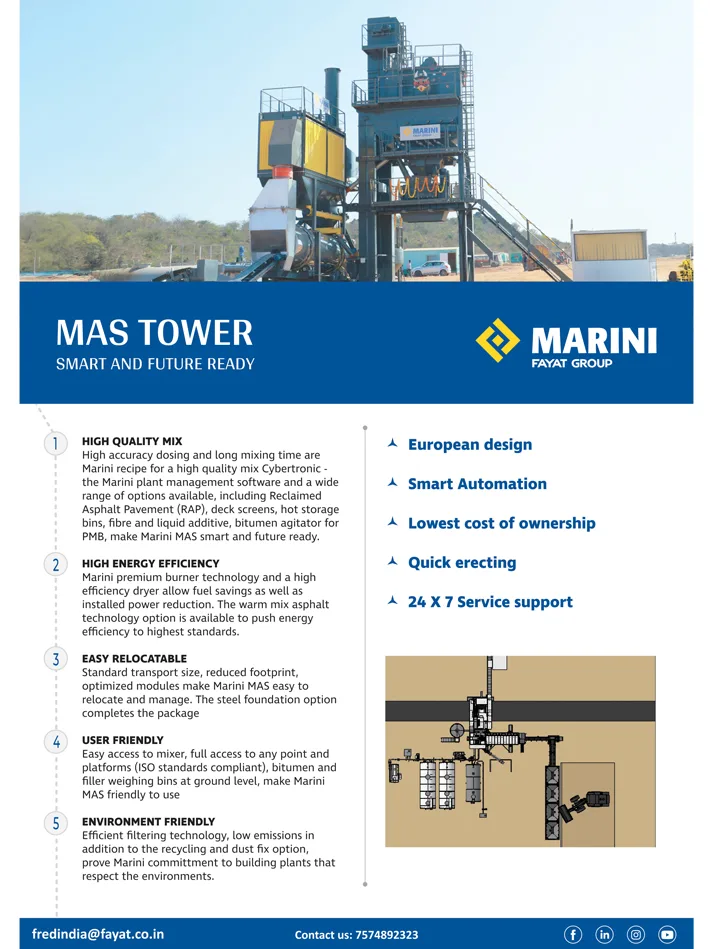
Indian manufacturers are also shaping adjacent segments critical to project delivery. Action Construction Equipment (ACE) has expanded its leadership across cranes, loaders and material handling equipment widely deployed across infrastructure and industrial projects, with growing exports reinforcing its positioning beyond the domestic market. Ajax Engineering has emerged as a global leader in self-loading concrete mixers — a category closely aligned with decentralised construction activity across regional markets — while Schwing Stetter India continues to scale batching plants, pumps and transit mixers from its Indian facilities, reinforcing mechanised concrete workflows across highways, metros and urban redevelopment.
The ecosystem is further strengthened by engineering and distribution capabilities from Larsen & Toubro, whose construction, heavy engineering and equipment partnerships play a critical role in fabrication, project execution and the supply of mining and earthmoving equipment across large infrastructure projects. This integration of manufacturing and project expertise deepens India’s execution capability beyond standalone equipment production.
Manufacturing capability is extending into specialised and high-capacity equipment. Indigenous development by BEML Limited across mining machinery, dump trucks and heavy equipment reflects India’s ability to move up the value chain beyond traditional earthmoving categories. Late-cycle product introductions across heavy excavators, automated concrete systems and connected road equipment highlight the increasing maturity of domestic engineering capability.
This growth is supported by a deepening supplier ecosystem. Fabrication specialists, hydraulic manufacturers, electronics providers and attachment makers are expanding alongside OEM facilities, enabling faster product refresh cycles and greater value addition within India. Machines are increasingly designed for multiple emission regimes at the production stage, strengthening export readiness while ensuring compatibility with evolving regulatory norms.
For regional contractors, these developments translate into broader equipment choice, improved service support and machines designed specifically for Indian operating realities — high utilisation, variable terrain and tight project timelines. Mechanisation is therefore spreading not only across mega projects but also into distributed infrastructure activity across smaller cities and industrial clusters.
The convergence of domestic manufacturing strength, contractor-driven product evolution and supply-chain maturity positions India as a structurally important construction equipment hub. By 2030, machines produced across Indian facilities — spanning excavators, backhoe loaders, cranes, concrete equipment and mining machinery — will serve infrastructure demand both within the country and across emerging markets. Made in India is no longer simply a manufacturing label; it reflects a design philosophy shaped by scale, efficiency and real-world operating conditions.
Engineering Intelligence: Digital, Automated, Low-Carbon
India’s construction transformation is increasingly driven by intelligence embedded inside machines. Productivity is now engineered through software, sensors, automation and energy efficiency as much as through mechanical capability, reshaping how projects are executed, monitored and financed.
Telematics-enabled fleets are becoming standard across highways, rail and mining projects. Platforms such as VisionLink from Caterpillar Inc. and LiveLink from JCB allow contractors to track fuel consumption, idle time, utilisation patterns and preventive maintenance remotely, creating unprecedented transparency in equipment performance. Intelligent compaction, automated batching and sensor-based paving — deployed by manufacturers including CASE Construction Equipment — are improving execution consistency while reducing material waste and rework.
Excavator upgrades from Tata Hitachi Construction Machinery and Hyundai Construction Equipment emphasise hydraulic efficiency, telematics-ready architecture and real-time operating analytics, directly influencing cost per cubic metre moved — the core metric of earthmoving productivity. In mining, fleet management ecosystems from Volvo Construction Equipment are enabling payload optimisation, predictive maintenance and coordinated fleet deployment, turning downtime reduction into a strategic advantage.
Automation is expanding across both project sites and manufacturing floors. GPS-enabled grading improves accuracy on expressways, while robotic fabrication and digital quality inspection ensure structural consistency before machines reach the field. Sustainability forms the second layer of this engineering shift: emission-compliant engines, fuel analytics and reduced idle hours are aligning operational efficiency with carbon reduction.
The impact is cumulative. Digitally monitored fleets operate longer, infrastructure assets last longer and lifecycle costs decline. By 2030, engineering excellence will be defined not only by physical structures but by the intelligence embedded within the machines that build them.
Electrifying the Build-Out: The Green Equipment Transition
Alongside digitalisation, electrification is emerging as the next frontier in construction equipment. While India remains diesel-dominant in heavy earthmoving and mining, compact electric equipment is gaining relevance in metro rail construction, urban redevelopment, warehousing, tunnelling and data-centre projects where emission and noise constraints are tightening.
Globally, Volvo Construction Equipment and JCB have introduced electric compact excavators, loaders and site equipment that create a technology base for future localisation. Caterpillar Inc. is advancing hybrid and battery-electric systems across construction and mining, while CASE Construction Equipment and Hyundai Construction Equipment are expanding low-emission compact portfolios globally, positioning India as a potential production base as domestic demand evolves.
India’s electrification pathway will likely be phased. Compact machines operating in dense urban environments offer the most immediate commercial viability, while hybrid systems provide a transitional solution for higher-horsepower equipment. Over time, localisation of batteries, power electronics and control systems — leveraging India’s broader electric mobility ecosystem — could enable cost-engineered electric CE platforms for emerging markets.
Electrification is increasingly tied to financing and procurement dynamics. ESG-linked funding, sustainability criteria in infrastructure tenders and smart-city policies are likely to accelerate adoption. Innovations such as swappable batteries, mobile charging units and renewable-powered site charging are gradually addressing infrastructure constraints.
By 2030, India’s equipment mix will be hybrid in character: diesel for high-intensity applications, electric compact equipment mainstream in urban projects and alternative fuels bridging harder-to-electrify segments. Electrification therefore represents not just an environmental shift but an industrial strategy that complements digital intelligence, strengthens export competitiveness and aligns India with the global transition toward cleaner construction.
Financing the Future: Capital, Confidence and Equipment Economics
India’s infrastructure expansion in 2025–26 rests on an increasingly mature capital framework. Elevated public capex continues under the Union Budget 2026–27, but the deeper story lies in the diversification of funding sources and improved financial discipline across the value chain.
PPP models in highways and airports are regaining traction, supported by clearer risk allocation and stronger dispute resolution mechanisms. Asset monetisation programs are unlocking capital tied up in operational toll roads and transmission assets, recycling funds into new greenfield projects. Infrastructure Investment Trusts (InvITs) are attracting institutional capital, reinforcing liquidity within the system.
This financial maturity has a direct bearing on equipment demand. When project pipelines are predictable and funding flows stable, OEMs gain confidence to invest in manufacturing capacity and new product launches. Companies such as JCB and Caterpillar Inc. have aligned their India capex expansions with sustained domestic infrastructure visibility. New assembly lines, upgraded fabrication units and automation investments are underpinned by long-term demand confidence.
Equipment financing itself is evolving. Banks and NBFCs are offering structured lending products tailored to fleet expansion cycles. OEM-backed financing arms are providing bundled service contracts with new machines, reducing upfront capital stress for contractors. The rise of organised rental companies is allowing mid-sized contractors to access high-value machines — including next-generation excavators and compactors — without heavy balance sheet exposure.
Rental penetration is particularly significant in segments like crawler excavators, wheel loaders and vibratory compactors. As projects under Dedicated Freight Corridor and metro expansions accelerate, short-term demand spikes are being met through rental fleets. This model increases equipment utilisation across the industry and stabilises OEM order books.
Foreign institutional investors are also deepening exposure to logistics parks, industrial corridors and renewable energy infrastructure. Their participation raises governance standards and increases scrutiny on execution timelines — indirectly pushing contractors toward higher mechanisation and digital transparency.
The financial ecosystem is therefore reinforcing the equipment multiplier effect. Access to capital determines fleet modernisation. Predictable funding accelerates product upgrades. Monetisation programs create headroom for fresh orders.
By 2030, India’s construction growth will be defined not just by engineering ambition but by capital discipline. The alignment of public capex, private investment, export growth and structured equipment financing creates a self-reinforcing cycle. Infrastructure builds confidence; confidence attracts capital; capital fuels further mechanisation.
The convergence of intelligent machines and intelligent financing models is what positions India uniquely. It is not merely expanding infrastructure — it is professionalising the entire ecosystem around it.
Skill, Safety and Standardisation: Raising the Global Benchmark
Infrastructure scale without skilled execution creates fragility. As India’s projects grow larger, faster and more technologically sophisticated, the real differentiator toward 2030 will not only be machines or capital — it will be human capability and operational discipline.
The transformation underway in 2025–26 is increasingly evident at the intersection of skill, safety and standardisation. Construction sites are no longer informal, labour-intensive zones operating on improvisation. Mega expressways, high-speed rail corridors, freight corridors and port expansions demand certified operators, digitally trained supervisors and adherence to global safety protocols.
The modern construction site is machine-dense. Telematics-enabled excavators from Caterpillar Inc. or Volvo Construction Equipment, advanced backhoe loaders from JCB, and intelligent compactors from CASE Construction Equipment are embedded with digital interfaces and performance dashboards. These machines require trained operators capable not only of mechanical handling but also of interpreting data alerts, fuel efficiency indicators and predictive maintenance notifications.
OEM-led training academies are therefore gaining importance. Several global manufacturers operating in India have strengthened operator training centres that simulate real-world project environments. This investment is strategic. A skilled operator enhances machine longevity, reduces fuel wastage and improves site safety — directly influencing project margins.
The emphasis on skill development also aligns with the government’s broader workforce development initiatives. As mechanisation deepens under programs like Bharatmala Pariyojana and large-scale rail expansion projects, certified machine operators are becoming essential. Informal labour pools are gradually being replaced by semi-formalised and trained workforces, particularly on high-value contracts with international funding.
Safety standards are evolving in parallel. Enhanced cabin ergonomics, 360-degree visibility systems, load monitoring alerts and stability control features are increasingly standard on new equipment platforms. Hyundai Construction Equipment’s newer excavator models manufactured in India emphasise operator comfort and advanced monitoring displays, while Tata Hitachi Construction Machinery has introduced improved cabin safety features and telematics-ready alert systems in its refreshed product lines.
Standardisation is the third pillar strengthening India’s global positioning. Historically, variability in execution quality was one of India’s infrastructure challenges. Today, standardised design codes, digital monitoring platforms and tighter procurement norms are reducing inconsistency. Intelligent compaction systems in road projects ensure uniform pavement density. GPS-enabled grading systems enhance precision. Digital project tracking reduces reporting ambiguity. The adoption of global emission norms across construction equipment further reinforces standardisation. India-manufactured machines are increasingly configured to meet multiple regulatory frameworks, enhancing export credibility and raising domestic quality thresholds.
This convergence of skill, safety and standardisation signals maturity. By 2030, India’s infrastructure competitiveness will depend not just on delivery speed but on reliability, durability and compliance. Skilled operators will manage intelligent fleets. Safety-certified sites will attract global capital. Standardised engineering protocols will elevate India’s reputation in overseas project execution.
For India to truly embody “Global by Design,” it must institutionalise this skill and safety evolution. The machines are ready. The capital is flowing. The standards are rising. The human ecosystem must rise alongside.
Where Capability Becomes Influence
By the end of this decade, India’s construction story will not be judged only by kilometres built or machines sold. It will be evaluated by something deeper — whether the country succeeded in building an ecosystem that is globally competitive, technologically aligned and structurally resilient. What is unfolding between 2025 and 2030 is not simply infrastructure expansion but industrial consolidation. The alignment of policy, manufacturing, digital intelligence and capital frameworks is creating a construction economy that operates with increasing coherence rather than fragmentation.
India’s advantage lies in its dual character — combining the urgency of a developing economy with the scale ambition of a major global power. This combination creates unique innovation pressure: solutions must be cost-efficient, scalable and durable while meeting global compliance standards. That pressure has forged a distinctive engineering culture.
The construction equipment industry reflects this evolution clearly. Global OEMs have embedded production depth locally while domestic manufacturers have strengthened design capability and supply chain integration. Product portfolios are aligning with international benchmarks. Electric-ready platforms, telematics-integrated machines and fuel-optimised systems are moving into mainstream deployment cycles.
This manufacturing maturity carries geopolitical significance. As global supply chains diversify and infrastructure demand accelerates across emerging markets, India is positioned as a reliable, cost-engineered production hub. The export opportunity extends beyond finished machines into components, fabrication systems and engineering services, strengthening India’s role across Asia, Africa and parts of the Middle East.
At the same time, the domestic market is becoming more sophisticated. Contractors are shifting toward data-optimised, performance-driven asset strategies. Rental ecosystems are professionalising; fleet analytics are influencing procurement and ESG metrics are shaping financing. The conversation is moving from acquisition to efficiency.
The most profound transformation lies in mindset. Infrastructure is increasingly viewed as a productivity asset rather than a political deliverable. Roads are evaluated for logistics efficiency, ports by turnaround times, rail corridors by freight velocity and machines by uptime and fuel intensity — aligning India with global performance standards.
Electrification and decarbonisation will further sharpen this trajectory. As urbanisation deepens and environmental scrutiny intensifies, cleaner construction technologies will move from pilot to priority. India’s broader electric mobility ecosystem provides a foundation on which electric construction equipment can scale, with early localisation shaping export leadership. None of this progress is automatic. It depends on sustained policy continuity, disciplined capital allocation and continued investment in skills. Manufacturers must continue upgrading facilities and platforms while maintaining quality under execution pressure.
If these conditions hold, India’s construction sector by 2030 will exhibit characteristics once associated with mature industrial economies: standardised execution, globally compliant manufacturing, integrated supply chains and technology-led productivity. The phrase “Global by Design. Indian at Core” therefore captures more than aspiration — it reflects a structural possibility. India’s strength lies in adaptive engineering: delivering scale with frugality, technology with pragmatism and growth with resilience.
As Construction Opportunities marks eleven years of chronicling this journey, the next chapter appears more decisive than any before it. The foundations — capital commitment, manufacturing capacity and engineering capability — are in place. The coming years will determine whether this alignment converts into global leadership. If it does, 2030 will mark not merely the completion of projects but the emergence of an integrated construction ecosystem influencing infrastructure development beyond India’s borders. That is not incremental progress. That is structural transformation.
7 Defining Signals of India’s Construction Surge
- India is the world’s 3rd largest construction equipment market, after China and the United States.
- Construction contributes ~8% of India’s GDP, making it one of the country’s largest employment and capital-intensive sectors.
- India’s electric construction equipment market is projected to grow at ~17–18% CAGR through 2030, signalling high-velocity adoption in emerging segments.
- The compact electric CE segment in India is expected to expand from ~USD 1.7–1.8 billion in 2025 to over USD 4.5 billion by 2031.
- Electric excavators account for roughly 30–35% of India’s electric CE segment in 2025, indicating early traction in urban and infrastructure applications.
- Telematics penetration in mid- and large-sized construction equipment now exceeds 60% in new sales, reflecting rapid digitisation of fleets.
- Equipment intensity per infrastructure project has increased significantly over the past decade, as tighter timelines and higher engineering standards drive deeper mechanisation.