
The Rise of Intelligent Lifting
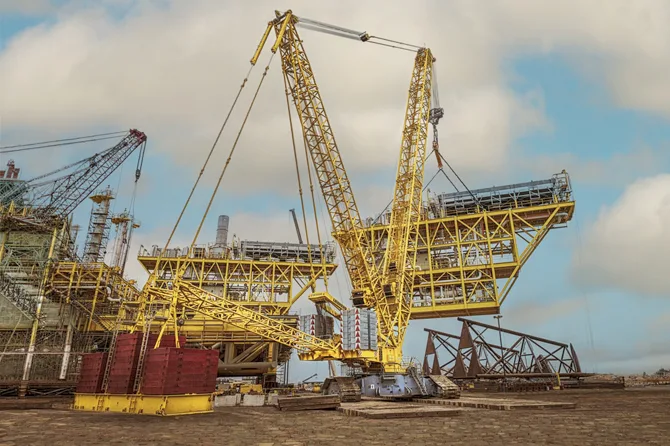
The crane industry is entering a decisive new phase—one where lifting capacity alone no longer defines value. As infrastructure projects grow larger, faster, and more complex, cranes are evolving into intelligent systems that shape how construction is executed. From embedded safety in high-volume pick-and-carry cranes to hybrid all-terrain platforms and digitally connected tower cranes, the shift is both technological and structural. In India, innovation is moving into core segments at scale; globally, it is advancing toward automation and electrification. This cover story explores how cranes are transitioning from machines to intelligent systems at the centre of construction execution…… writes, PRERNA SHARMA.
Value is shifting beyond lifting capacity and equipment deployment toward how effectively lifting solutions align with increasingly demanding execution environments. As project timelines compress and site conditions become more complex, the role of the crane is expanding—from a supporting asset to a central driver of productivity, safety, and coordination. This shift is not cyclical; it is structural. Engineering, digital capability, and operational intelligence are beginning to converge, reshaping how cranes are designed, deployed, and evaluated across both global and Indian markets.
The Global Shift: Lifting More Is No Longer Enough
The global crane market continues to grow at a steady, predictable pace, but the underlying dynamics of that growth are evolving. The tower crane segment, currently valued at approximately USD 6–8 billion, is projected to reach USD 10–11 billion over the next decade, expanding at a CAGR of around 4–6%, as indicated by Future Market Insights and Research and Markets. The mobile crane segment, which serves a broader spectrum of applications—from infrastructure and industrial construction to energy and logistics—continues to expand in parallel. Its growth is supported by ongoing investments in transportation networks, utilities, and industrial capacity, as highlighted by Grand View Research. However, these figures only reflect the surface of the market. The deeper transformation is qualitative.
Across developed markets, cranes are increasingly being embedded within a digitally connected construction ecosystem. Telematics platforms now enable real-time tracking of utilisation, load cycles, and equipment health. Predictive maintenance systems are reducing downtime by anticipating failures before they occur. Automation is improving precision, particularly in tower crane operations where anti-sway and positioning systems are reducing cycle times.
What this effectively means is that cranes are no longer evaluated purely on mechanical specifications. Their value is being defined by how efficiently they operate over time, how seamlessly they integrate with project workflows, and how reliably they deliver under continuous load conditions. As highlighted in industry observations, the crane is transitioning from a standalone machine to a data-generating, performance-driven asset within a larger execution system. This marks a fundamental shift—from capacity-led competition to capability-led differentiation.
India’s Opportunity: Volume Growth Meets Structural Transition
India’s crane market reflects a very different, yet equally compelling, trajectory. It is one of the fastest-growing crane markets globally, but its evolution is shaped by a unique combination of scale, diversity, and uneven technological adoption. The market is currently estimated at around USD 1.5–1.6 billion and is expected to exceed USD 2 billion by the end of the decade, growing at approximately 6–7% CAGR, according to Mordor Intelligence. Longer-term projections from IMARC Group indicate that the market could expand beyond USD 5 billion, driven by sustained investments across infrastructure, urban development, and industrial sectors. Yet, what defines India is not just growth—it is how that growth is distributed and absorbed.
The market operates across multiple layers. At the upper end are large EPC contractors and infrastructure developers executing metro rail systems, expressways, airports, and energy projects. In these environments, cranes are treated as critical productivity assets. Equipment selection is increasingly tied to uptime, precision, and integration with project schedules. Technology adoption—whether in the form of telematics, safety systems, or advanced controls—is becoming embedded in execution.
At the same time, a large portion of the market continues to operate under cost-sensitive conditions. Smaller contractors and regional developers often prioritise acquisition cost over lifecycle performance. For them, cranes remain largely mechanical tools, with limited digital integration. This creates a dual-speed market, where advanced and conventional technologies coexist. As noted in recent assessments, this layered structure is shaping the pace at which innovation diffuses across the Indian crane ecosystem.
Mobile Cranes: Where Scale Meets Versatility
Mobile cranes dominate not just India’s crane market, but also represent the largest and most versatile segment globally. Their relevance stems from a simple advantage—mobility combined with lifting flexibility—which aligns with both distributed infrastructure projects and complex industrial applications. Globally, the mobile crane market is already a sizeable segment. Estimates suggest it is valued at over USD 11 billion in 2025 and projected to reach nearly USD 17–18 billion by the early 2030s, growing at a CAGR of around 5–6%. Other projections place the segment slightly lower in the near term—around USD 9–11 billion through the decade with ~3–4% CAGR—but the direction remains consistent: steady, infrastructure-led expansion. This global scale reflects the segment’s role as the primary execution tool across construction, energy, logistics, and industrial projects.
In India, this dominance is even more pronounced. Mobile cranes account for over 60% of total crane deployments, according to Mordor Intelligence, making them the operational backbone of the construction ecosystem. The growth trajectory is also stronger than the global average. The India mobile crane market is expected to expand at a CAGR exceeding 9%, driven by highways, rail corridors, industrial development, and renewable energy projects, particularly wind installations.
Within this segment, pick-and-carry cranes define the Indian market structure. They account for a substantial share of total unit volumes—often estimated at over two-thirds of the market—due to their ability to lift and transport loads simultaneously without requiring stabilisation systems. This makes them uniquely suited to India’s fragmented and space-constrained job sites.
At the same time, the composition of demand is gradually shifting. While lower-capacity cranes continue to dominate volumes, there is increasing demand for mid- and high-capacity cranes (50 tonnes and above), particularly in infrastructure and energy projects. Globally, similar trends are visible, with higher-capacity all-terrain and crawler cranes gaining traction in sectors such as wind energy and large-scale infrastructure.
Technology adoption is also beginning to reshape the segment. Telematics, remote diagnostics, and load monitoring systems are increasingly being integrated, particularly among organised fleet operators. This is gradually moving mobile cranes away from purely mechanical assets toward data-enabled, performance-optimised equipment. In essence, mobile cranes are no longer just about moving loads—they are becoming central to how efficiently those loads are moved across increasingly complex project environments.
Vertical Construction: Where Tower Cranes Take Center Stage
While mobile cranes dominate in volume, tower cranes play a structurally critical role in both global and Indian markets—anchoring the shift toward vertical construction. Globally, the tower crane market is comparatively smaller but highly specialised. It was valued at approximately USD 6–6.5 billion in 2025 and is expected to reach around USD 9–10 billion by the early 2030s, growing at a CAGR of 5–6%. Some estimates extend this trajectory further, indicating continued expansion toward USD 11 billion+ by the mid-2030s. What is particularly significant is the regional concentration of demand. Asia-Pacific alone accounts for close to 35–40% of global tower crane demand, driven by rapid urbanisation and high-rise construction.
In India, the tower crane segment is smaller in size compared to mobile cranes but is growing steadily alongside urbanisation. Estimates suggest the market could expand from around USD 1 billion to over USD 1.5 billion over the next decade, reflecting a CAGR of 6–7%, as indicated by TechSci Research. The drivers here are structural rather than cyclical.
India’s urban landscape is undergoing a clear transition toward vertical development. High-rise residential, commercial, and mixed-use developments are no longer limited to metros. Tier-1 and Tier-2 cities are increasingly adopting vertical formats, driven by land constraints and changing real estate economics. Tower cranes are central to this shift because of their ability to deliver high lifting capacity at height within a fixed footprint—a critical requirement in dense urban environments.
Their role is even more pronounced in large infrastructure projects. Metro rail systems, airports, and commercial complexes increasingly rely on tower cranes for continuous, high-precision lifting operations. In such environments, multiple cranes often operate simultaneously within limited space, driving the adoption of advanced systems such as anti-collision technologies.
Globally, similar trends are shaping the segment. The increasing use of flat-top and luffing jib cranes, along with the growing integration of automation and digital monitoring systems, reflects the need for precision and coordination in complex projects. Another emerging factor is the rise of industrialised construction. As precast and modular building methods gain traction, the need for repetitive, accurate lifting is increasing—further strengthening the role of tower cranes.
Despite these advantages, adoption in India remains concentrated among large developers and organised contractors. High capital costs, installation complexity, and skill requirements continue to limit broader penetration. However, as urban construction becomes more vertical and project complexity increases, tower cranes are expected to play an increasingly central role.
Shifting Paradigms: From Equipment to Execution Systems
The growth of the crane market is underpinned by familiar drivers—urbanisation, infrastructure investment, and industrial expansion. However, what is more important today is how these drivers are reshaping expectations from lifting equipment. Construction projects are becoming more complex and tightly managed. Delays are costlier, safety requirements are stricter, and efficiency is increasingly non-negotiable. In this context, cranes are no longer evaluated solely on their ability to lift loads. They are being assessed on how reliably and predictably they can support execution.
One of the most significant shifts is the growing role of data. Cranes are now capable of generating continuous streams of operational information, enabling better visibility into utilisation, performance, and maintenance needs. This is gradually influencing decision-making, particularly among larger players, where lifecycle performance is beginning to take precedence over upfront cost. At the same time, the industry faces a critical constraint in the form of skilled manpower. As cranes become more advanced, the gap between machine capability and operator skill is becoming more evident. This is shaping both the pace and effectiveness of technology adoption.
Sustainability, while still emerging in India, is beginning to influence certain segments, particularly in urban construction. The gradual introduction of electric and hybrid cranes indicates a shift that is likely to gain momentum over time. Perhaps the most transformative change, however, lies in integration. Cranes are increasingly being viewed as part of a broader construction ecosystem. As digital project management tools and BIM platforms become more prevalent, cranes are being integrated into coordinated workflows, enabling better planning and execution. This shift is subtle but significant. It moves the crane from being a standalone piece of equipment to becoming a central node in a connected construction system.
New Launches: Engineering the Next Lift
The 2025–26 cycle of crane launches and strategic moves reflects a deeper transformation than a conventional product refresh. Across markets, manufacturers are no longer focused solely on what cranes can lift, but on how they behave, adapt, and integrate within increasingly complex construction ecosystems. Engineering is being reoriented toward predictability, control, and coordination—while strategic partnerships are expanding the very definition of what a crane can do.
In India, this transition is most visible within the core of the market—where high-volume equipment is being fundamentally re-engineered. At EXCON 2025, Action Construction Equipment Ltd. (ACE) demonstrated how intelligence is moving into everyday lifting. The NX 230 introduces a single-chassis architecture that reduces oscillation and improves load stability on uneven terrain, while the FC 150 integrates a clutchless transmission system, enabling smoother and more consistent operation over long cycles. At the upper end, the F250 Ultra consolidates multiple safety layers—load sensing, articulation monitoring, and stability controls—transforming the crane into a system that actively regulates its own operating envelope.
This product evolution is now being extended into higher-capacity segments through ACE’s partnership with Kato Works Co., Ltd., marking its entry into truck, crawler, and rough terrain cranes. The significance lies not just in new products, but in the localisation of advanced engineering—aligning global technology with India’s expanding infrastructure scale.
A different but equally important direction is visible in the recent launches from TIL Limited, where innovation is centred on functional capability and operational efficiency. The CarryKing 515 stands out for its ability to combine lifting, load carrying, and full rotational movement within a single platform. With a 15-tonne lifting capacity, 360° slew, 4×4 drive, and four-wheel steering, the machine can lift, transport, and reposition loads without requiring additional handling equipment—significantly reducing cycle times and improving material flow, particularly in congested and uneven site conditions.
The TMS-885 truck-mounted crane, with an 85-tonne capacity and boom length exceeding 40 metres, is designed for infrastructure applications requiring both reach and mobility. It incorporates refined hydraulics for smoother load handling, improved braking systems for better control under load, and enhanced fuel efficiency for extended operating cycles. Its ability to deliver stable lifting at higher radii makes it well suited for bridge construction, industrial erection, and heavy infrastructure projects.

As Alok Kumar Tripathi, Whole-Time Director and President, highlights, the focus is on strengthening TIL’s position as a globally competitive crane manufacturer, with a sharper emphasis on high-capacity and performance-driven equipment. This is reflected in machines engineered to deliver greater lifting stability, multi-functional capability, and consistent performance under demanding operating conditions, enabling higher productivity within a single operating cycle.
At scale, Escorts Kubota Limited continues to influence the market through its Hydra series, including Hydra 14 and Hydra 16, where incremental improvements in braking, ergonomics, and fuel efficiency gradually elevate baseline performance across thousands of deployments. This layer of the market, while less visible, is critical—it is where innovation diffuses most widely.
At the higher end of the market, XCMG is aligning its portfolio with increasingly complex and sustainability-driven applications. Its crawler cranes from the XGC series continue to anchor heavy lifting in sectors such as wind energy and infrastructure, where precision and stability are critical.
However, the more significant shift is visible in its global launches. In 2025, XCMG introduced the XCA60_EV, the world’s first hybrid all-terrain crane, at major European exhibitions. Equipped with an oil-electric hybrid drivetrain, the crane is designed to reduce fuel consumption and carbon emissions by up to 40%, while also enabling fully zero-emission lifting operations through a plug-in electric system. With a 60-tonne capacity and integrated dual-drive system, it represents a move toward energy-flexible lifting, where cranes can switch between electric and conventional modes depending on operating conditions.
This is complemented by other advanced all-terrain models such as the XCA80G7-1E and XCA250G7-1E, which incorporate remote-control capability, dual-hook coordination, and 360-degree vision systems for enhanced operator awareness and safety. These features point toward a broader shift—not just toward higher capacity, but toward digitally assisted and remotely operable lifting environments.
In parallel, XCMG has accelerated its global expansion in 2026, with multiple deliveries of high-capacity cranes across international markets, particularly in Europe and emerging infrastructure regions. This reflects growing acceptance of its next-generation, low-emission and intelligent crane platforms, especially as fleet owners transition toward sustainability and operational efficiency.
SANY continues to expand its global crane portfolio with a strong emphasis on scale and application diversity. At CONEXPO 2026, the company showcased a broad lineup of equipment, including multiple crane platforms, underscoring its push into high-capacity and globally competitive lifting solutions. Crawler crane models such as the SCC800A and SCC1000A remain central to its offering, particularly in infrastructure and renewable energy projects. These machines are designed for modular transport, high structural stability, and efficient assembly, making them suitable for large, distributed project environments. SANY’s approach combines cost-efficient engineering with increasing integration of monitoring and control systems, enabling operators to manage lifting operations with greater visibility and consistency. As projects grow in scale—particularly in wind energy and industrial construction—this balance between capacity, adaptability, and operational control is becoming increasingly critical.
In more specialised lifting environments, Palfinger is bringing a distinct focus on precision-led lifting through models such as the PK 480 TEC loader crane. Designed for urban, utility, and logistics applications, the crane is engineered for controlled movement, where accuracy and operator assistance are critical. Advanced control interfaces and improved boom kinematics enable smoother positioning, reducing variability in complex lifting tasks.

As Armin Schlamp, VP – Corporate Marketing & Communications, Palfinger AG, highlights, the company is focused on delivering solutions that go beyond conventional lifting by integrating “intelligent systems and services” into its equipment. This is further reinforced by Alexander Susanek, COO, Palfinger AG, who

emphasises the importance of combining mechanical performance with digital capabilities to enhance operational efficiency. In practical terms, this translates into cranes that deliver greater operator support and consistent performance across repetitive cycles—a critical advantage in applications where margin for error is minimal.
In the industrial crane segment, Konecranes is reinforcing its shift toward electrified and digitally connected lifting systems. Its latest developments highlight the growing role of electric drive technology as a common platform across crane systems, enabling more energy-efficient and consistent operations. Electric drives are being increasingly integrated into crane platforms to support lower emissions, reduced energy consumption, and smoother load control, particularly in continuous-duty environments. This transition is not limited to sustainability—it also improves operational precision and maintenance standardisation, as electric systems allow for more predictable performance across varying load conditions.
The integration of platforms such as TRUCONNECT remote monitoring further strengthens this approach, providing real-time visibility into crane usage, load cycles, and equipment health. This enables predictive maintenance and ensures consistent performance over extended operating cycles. What distinguishes Konecranes in this context is its focus on combining electrification with digital intelligence. Rather than treating sustainability as a standalone feature, it is being embedded into the core architecture of crane systems—resulting in equipment that is not only cleaner, but also more stable, efficient, and easier to manage over its lifecycle.
Globally, the role of cranes is expanding even further—into entirely new construction paradigms. ICON’s collaboration with Palfinger represents one of the most significant developments in this direction. Through the integration of crane-based positioning systems into large-scale robotic 3D printing platforms like the Titan system, cranes are becoming part of automated construction workflows. In this context, they are not just lifting devices—they are precision enablers within robotic construction systems, supporting continuous, layer-by-layer building processes. This shift has implications beyond technology, addressing labour constraints, speed of execution, and consistency in construction.
Tadano continues to strengthen its global position in the heavy-lift segment through advanced all-terrain crane platforms. Recent deployments of models such as the AC 7.450-1 and AC 5.250L-2 highlight the increasing demand for cranes that combine high capacity with compact design and extended reach. The AC 7.450-1, with a 450-tonne lifting capacity and boom length approaching 80 metres, is engineered to deliver high performance while maintaining strong jobsite accessibility—effectively bridging the gap between larger 8-axle cranes and more compact configurations . Meanwhile, the AC 5.250L-2, with a 250-tonne capacity and lifting radius of up to 88 metres, is designed for applications requiring both reach and flexibility .
Zoomlion is reinforcing its global presence through large-scale tower crane deployments in some of the world’s most demanding urban construction environments. In Dubai, its cranes have played a central role in multiple landmark projects, including the Ciel Dubai Marina, the world’s tallest hotel at over 377 metres. Models such as the L250-20 luffing jib crane have been deployed as primary lifting equipment in ultra-high-rise construction, delivering the precision and stability required at extreme heights. In parallel, cranes like the L125-10FQ are being used across multi-tower developments, supported by advanced electronic control systems and compact mast designs that enable efficient operation in space-constrained sites.
What stands out is Zoomlion’s ability to execute large-scale, multi-crane coordinated operations, with projects in Dubai deploying dozens of cranes simultaneously. This reflects a shift toward cranes that are not only powerful individually, but capable of operating as part of synchronised lifting systems in dense urban environments.
Liebherr continues to advance crane performance through refined engineering in specialised applications. Its latest HS 8100.2 duty cycle crawler crane, showcased at CONEXPO 2026, reflects a clear focus on higher power, improved productivity, and operational efficiency. With a 100-tonne capacity, the crane features 15% higher engine power and a 9% increase in winch line pull, enabling it to handle heavier slurry wall grabs and deliver stronger performance in demanding applications such as deep foundation work and dynamic soil compaction. The increased power also translates into faster cycle times, as loads can be lifted and repositioned more quickly, directly improving on-site productivity.
Beyond performance, the HS 8100.2 introduces a more user- and service-friendly design, including improved accessibility, simplified maintenance systems, and faster setup enabled by its compact transport configuration. Features such as integrated monitoring of drive systems and redesigned rope handling further enhance operational efficiency.
From Lifting Power to Execution Intelligence
What emerges from this landscape is not a series of isolated innovations, but a clear convergence toward a new operating model. In India, intelligence is being embedded into high-volume equipment—enhancing stability, simplifying operation, and optimising workflows at scale. Globally, the shift is accelerating toward automation, electrification, and integration with digital and even robotic construction systems.
The implication is transformative. Cranes are no longer defined by how much they can lift, but by how effectively they can sense conditions, adapt in real time, coordinate with other systems, and integrate into data-driven environments. The market now stands at the threshold of a new phase. What appears as incremental progress is, in reality, the early stages of a structural redefinition—one where cranes evolve from tools of lifting to systems of execution.
Globally, cranes are becoming connected, responsive, and increasingly autonomous—capable of optimising their own performance within complex project ecosystems. In India, the transition is unfolding through scale, with intelligence gradually permeating core segments. Different trajectories, but a shared destination. The definition of value is shifting—from capacity to control, continuity, and coordination. Future-ready cranes will not be judged by peak capability, but by how consistently they deliver performance across cycles, sites, and conditions—with minimal intervention.
The 2025–26 launch cycle offers a preview of what lies ahead. Embedded intelligence, hybrid propulsion, remote operation, and system integration are no longer experimental—they are becoming foundational. The crane is beginning to operate not as an isolated machine, but as part of a connected construction ecosystem.
This evolution may still be taking shape, but its direction is clear. Cranes are transitioning into intelligent, adaptive nodes within the construction value chain—influencing not just how loads are lifted, but how projects are planned, sequenced, and executed in real time. In that future, the crane will not simply respond to construction. It will actively shape it.
Fast Facts
- Tower crane market, valued at ~USD 6–8 billion, is projected to reach USD 10–11 billion by 2033 (CAGR ~4–6%).
- Mobile crane market, estimated at USD 11–12 billion, is expected to reach USD 17–18 billion by early 2030s (CAGR ~5–6%).
- Asia-Pacific accounts for ~35–40% of global tower crane demand – Fortune Business Insights.
- Total crane market, valued at ~USD 1.5–1.6 billion, is expected to cross USD 2 billion by 2030 (CAGR ~6–7%).
- Mobile cranes account for 60%+ of deployments in India while pick-and-carry cranes contribute ~65–70% of unit volumes.
- India mobile crane segment is growing at ~9%+ CAGR, led by roads, rail, and renewable energy.