
Rewriting MINI EX PLAYBOOK
As global infrastructure investment surges and sustainability mandates tighten, the mini excavator segment has emerged as the epic enter of construction innovation in 2025. No longer mere compact diggers, today’s mini excavators blend zero‑emission electric powertrains, AI‑driven telematics, and semi‑autonomous controls to deliver unprecedented productivity in urban, industrial, and rural projects alike. At the same time, the rapid growth of rental and Equipment‑as‑a‑Service platforms is democratizing access to these high‑tech machines, Electrify, Automate, Mobilize: The 2025 Mini Excavator Playbook, allowing contractors of every scale to tap into the latest advances without hefty capital outlay. Against a backdrop of regional divergences—from Europe’s emission‑free zones to Asia‑Pacific’s infrastructure boom—OEMs are racing to balance affordability, durability, and digital capability in machines designed for tomorrow’s jobs…. writes, PRERNA SHARMA.
As of 2025, the global mini excavator market is undergoing a profound transformation—one shaped by regional construction dynamics, stringent environmental mandates, powertrain innovation, and evolving user expectations. Valued at over USD 9 billion, the segment has grown beyond its niche roots to become central to infrastructure, utility, and urban development projects across both mature and emerging economies. While traditional segmentation revolved around size and powertrain, today’s market is increasingly defined by digital intelligence, regulatory alignment, and end-use versatility. This evolution is unfolding at different paces across geographies, each bringing distinct priorities and challenges to the fore.
A Global Snapshot: Markets in Motion
Asia-Pacific continues to dominate the mini excavator landscape, with countries like China, India, and Indonesia seeing surging demand driven by rapid urbanization, industrial expansion, and a push for space-efficient construction tools. China and Japan are leading in the adoption of electric and semi-autonomous models, while India—though still largely diesel-driven—is making strides in digital integration, especially in smart city initiatives.
North America presents a technologically mature market where electrification is no longer aspirational but increasingly mainstream. Regulatory incentives, heightened environmental awareness, and an expanding charging infrastructure are propelling growth. Rental penetration remains high, and fleet managers are prioritizing machines with low maintenance requirements and built-in telematics for real-time tracking and diagnostics.
Europe is at the forefront of green construction, propelled by EU Stage V emissions standards and urban zero-emission zones. Scandinavian countries, Germany, the Netherlands, and the UK are aggressively adopting electric mini excavators, particularly in retrofitting and municipal projects. Intelligent features—operator assist, geofencing, remote diagnostics—are now standard fare for high-end models as the region grapples with labor shortages and productivity demands.
Conversely, Latin America and Africa represent emerging markets, with steady but slower adoption. Here, durability and simplicity are paramount, with entry-level diesel models dominating sales. Yet, a growing influx of cost-effective machinery from Chinese and Indian OEMs is accelerating accessibility and penetration.
From a powertrain perspective, diesel remains dominant, especially in regions where charging infrastructure is limited. However, electric mini excavators are the fastest-growing sub-segment, propelled by regulatory backing and demand for low-noise, low-emission solutions. Hybrid machines are also carving out niche roles in markets that demand runtime flexibility without compromising sustainability.
Machine size remains a crucial differentiator. Sub-2-ton mini excavators are preferred in dense urban environments, particularly in Europe and North America. The 2–3-ton range, offering the best balance of performance and portability, leads global sales. Meanwhile, the 3–6-ton category is gaining traction for heavier-duty municipal and industrial applications.
Across all regions, demand is booming in the construction and infrastructure sector—foundation work, trenching, road repair—while landscaping has emerged as a key driver in the West. Agricultural and utility use, though more niche, are growing steadily, particularly in Asia and Latin America.
Rental continues to define developed economies, where more than half of all mini excavator sales are absorbed by leasing firms. Their focus on ROI, uptime, and fleet analytics is shaping OEM R&D priorities, pushing manufacturers to build smarter, more durable machines with modular upgrades.
India’s Inflection Point: Compact, Connected, and Ready to Scale
Among the most dynamic mini excavator markets in 2025 is India—where urban density, ambitious infrastructure targets, and a growing appetite for technology-driven construction tools are converging to drive rapid adoption.
Historically viewed as a diesel-centric, cost-sensitive market, India is now shifting toward compact, intelligent, and increasingly connected construction equipment. According to IMARC Group, the Indian excavator market reached USD 3.37 billion in 2024 and is expected to grow to USD 9.13 billion by 2033, at a CAGR of 11.7%. Mini excavators, though still a smaller segment, are growing faster. Off-Highway Research forecasts a 13% increase in sales to 3,600 units by 2026 and 4,000 units by 2027.
A key driver of this growth is the integration of IoT-enabled telematics, which has transitioned from a luxury to a necessity. Real-time diagnostics, predictive maintenance, and geolocation tracking are now critical features, especially in time-sensitive infrastructure projects. For rental operators and contractors, these technologies help minimize downtime and stretch asset performance—crucial in a market where every hour counts.
Electrification, while still emerging, is beginning to gain ground—particularly in metro areas and municipal projects with environmental mandates. Although global players like Volvo CE and Bobcat have introduced battery-powered models abroad, Indian OEMs are actively monitoring the space. Specialized applications—indoor sites, utility work, noise-sensitive zones—are likely to be the first adopters before broader acceptance follows.
Meanwhile, automation is streamlining operations in a labor-constrained environment. Features like auto-idle, intelligent hydraulics, and operator-assist technologies are helping bridge the skills gap, enabling novice users to achieve professional-grade performance. These advancements not only boost efficiency but also reduce long-term operational costs.
Smart attachment recognition, another emerging innovation, allows mini excavators to identify tools and self-adjust settings. This facilitates seamless transitions between tasks—digging, grading, lifting—while extending equipment life and improving site productivity.
Data-centric fleet management is further redefining equipment ownership models. With cloud-based analytics, contractors and rental firms can now optimize procurement cycles, maintenance schedules, and fuel usage—an especially powerful tool for India’s growing SME construction segment.
India’s mini excavator market is moving from brute force to smart force—with connected, compact machines that meet the demands of a modern construction ecosystem. As the country advances its infrastructure and smart city ambitions, mini excavators will be pivotal in addressing urban space constraints, labor shortages, and environmental compliance.
Forging the Future: OEMs Reshaping Mini Excavator Landscape
Globally the compact equipment sector is undergoing a pivotal transformation, driven by a wave of OEM-led innovation that fuses sustainability, digital intelligence, and machine versatility. From fully electric and hydrogen-powered mini excavators to models purpose-built for India’s urban, agricultural, and infrastructure needs, global and domestic manufacturers are rewriting the blueprint for performance, productivity, and environmental responsibility. These innovations are not just meeting market demands—they are actively shaping them, as equipment becomes smarter, cleaner, and more adaptable to the country’s complex construction ecosystem.
Bobcat – Advancing Compact Performance and Electrification: Bobcat has rolled out its next-generation mini excavators—E16, E17z, E19, and E20z—integrating over 500 new components aimed at enhancing machine responsiveness, fuel efficiency, and operator comfort. A notable innovation is the load-sensing hydraulic system that ensures smooth multitasking, while more compact designs allow for superior maneuverability in tight urban environments. The introduction of the Fritzmeier cab in models like the E88 further elevates operator comfort with reduced noise and vibration levels.
Hyundai – Dual Strategy—Electric and Hydrogen Power: Hyundai Construction Equipment Europe is entering the electric mini excavator market. The company just launched its first battery electric mini excavator — the HX19e. Hyundai’s new mini excavator weighs in at 5,062 lbs (2,296 kg) when equipped with a full cab and large capacity battery pack. According to Hyundai, the HX19e is a great option for urban utilities, landscaping and gardening, tunnel and basement excavation and for many local authority tasks, such as cemeteries and sports facilities. Customers can choose between 32- and 40-kWh lithium-ion battery packs for the HX19e. Hyundai said the 40-kWh battery will allow customers to work for over 10 hours between charges. The mini excavator features a Type 2 connector so customers can use existing EV charging infrastructure. the batteries in the HX19e power a 13-kW electric motor, that in turn drives an open center hydraulic system. The new electric model boasts similar performance to Hyundai’s diesel-powered HX19A mini excavator, as well as the same 16-kN bucket breakout force. Other specs include a 9.4-kN dipper arm breakout force, maximum digging depth of 2,340 mm and maximum digging reach of 3,940 mm.
JCB’s lineup of compact excavators ranges from 1 to 10 metric tons and features spacious cabs with operator-friendly layouts, low-effort joystick controls and excellent visibility, according to Lee Tice, product manager. Select models feature a 7-inch color display to access machine features and performance metrics. Advanced hydraulics with proportional auxiliary control provide smooth handling of attachments, greater precision and faster cycle times. Bronze graphite-impregnated bushings enable 500-hour greasing intervals.
Models up to 3.5 metric tons have Perkins engines, while larger machines are powered by Kohler engines. JCB offers two versions of its popular 19C-1 – diesel and the electric 19C-1E. Both are conventional tail swing with 101 inches of maximum dig depth and 103 inches of maximum dump height. Operating weights are 4,211 pounds for the diesel and 4,193 pounds for the battery electric models. The 19C-1E has all the performance of the 19C-1 for use indoors or other areas where noise and fumes are restricted.
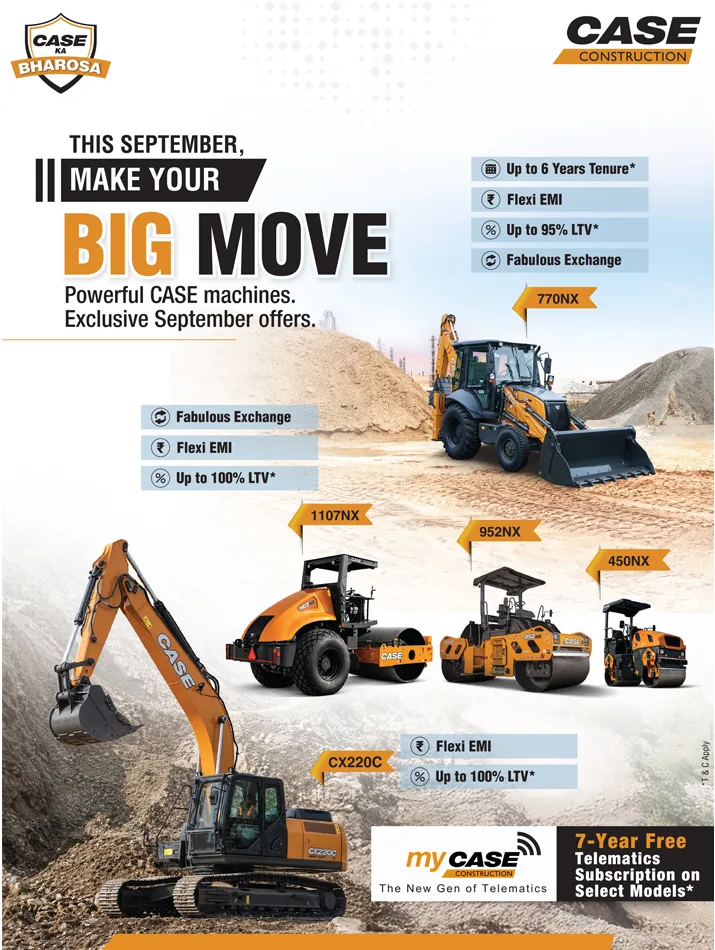
CASE: The 5-metric-ton Case CX50D mini excavator combines more punch in a compact design for greater lifting capacity and better digging performance, the company says. Versatile hydraulics support advanced attachments such as tiltrotators and mulchers. Operators benefit from a comfortable, automotive-style cab featuring adjustable seating, automatic climate control and an intuitive 7-inch LCD screen.
Cat: Caterpillar Ease of Use for compact excavators includes Indicate, an entry-level grade system; E-Fence, for setting geo boundaries; Swing Assist for return-to-trench auto positioning; and Bucket Assist to maintain bucket angle, according to Greg Worley, Cat market professional. It has been standard on 306 CR through 310 CR models and is coming to the 305 CR in 2025.
Komatsu – Urban Mobility Meets Compact Design: Komatsu has come up with a whole bouquet of innovation packed on an all-new prototype 7.5-tonne wheeled excavator which joins the PW98MR and PW138MR wheeled excavator family. “This new tight-tail excavator fills the gap below the mid-sized wheeled excavators, granting easy and precise operability with any attachments and the best driving experience on the roads, packed in a super compact machine perfectly sized to work in an urban environment,” says Alex Visentin, product manager for the new wheeled excavator. “This 7.5-tonne wheeled excavator takes full advantage of Komatsu group synergy and know-how to offer high versatility, ease of buying, and peace of mind with the factory-fitted Lehnhoff Powertilt option.”
This machine can work in a wide variety of utility and landscaping applications with improved efficiency and is a first choice for heavy-duty lifting applications or simple excavating tasks in narrow alleys, road construction sites and for sewer construction work. Its swing boom design allows digging parallel to buildings or barriers and the two-piece boom design grants flexibility with an extended working diagram.
Hitachi and KTEG – Digital-Driven Compact Efficiency: Eight new mini and compact excavators appeared at Bauma 2025. Seven of these models, ranging from one to six tonnes, are a result of the KTEG joint venture between Hitachi Construction Machinery Co., Ltd. (HCM) and Kiesel Technologie Entwicklung GmbH. The nine-tonne compact ZX95US-7 excavator is manufactured by HCM. The smallest model is the one-tonne KTEG 10U SL, based on the Hitachi ZX10U-6. It has several new features that enhance operator comfort and safety, such as repositioned joysticks for easy operation, convenient access from either side of the machine’s console, and a new seatbelt.
Based on the Hitachi ZX19U-6 mono boom model, the KTEG 19U offers enhanced versatility with a two-piece boom. This varies the working height of the excavator, making it more suitable for working in confined spaces, such as under bridges. KTEG also introduced its new six-tonne compact excavator, the KTEG 63US. Its two-piece boom extends the working range, which is perfect for demolition in urban areas, as well as general construction, road construction and landscaping. The lifting capacity is increased by 30% to carry out heavy duty work, and it has a 20% greater cutting height, and 25% greater dumping height than the standard ZX55U-6, which makes it ideal for loading materials on to trucks.
Hitachi’s line of Zaxis 5N compact excavators feature a host of upgrades including in-cab flow rate adjustment on the ZX50U-5N and ZX60USB-5N, blade float option on the ZX30U-5N to ZX60USB-5N and complete hydraulic quick coupler and second auxiliary piping on premium versions of the ZX30U-5N through the ZX60USB-5N, according to Patrick Baker, product manager.
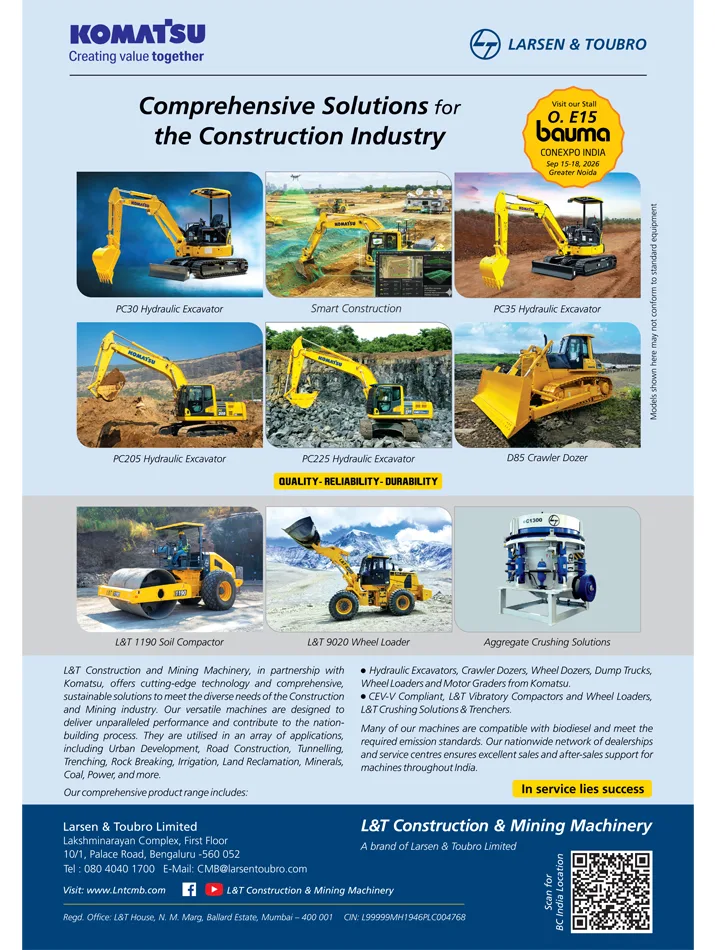
L&T-Komatsu: Purpose-Built for Indian Urban Realities: At BAUMA CONEXPO INDIA 2024, Komatsu and L&T Construction & Mining Machinery unveiled the Komatsu PC35MR-3 Mini Hydraulic Excavator. The PC35MR-3 is designed for scenarios which require powerful performance in a limited space. It possesses impressive tractive force and digging capacity, excellent reach performance and high flexibility in fuel consumption and mobility. The wide angled banding boom provides accurate trenching of a straight line and easier foundation digging compared to motions at corners and edges.
It means that PC35MR-3 cuts operating expenses while reducing the demand for manual labor to an absolute minimum and boosts productivity. It easily breaks-even due to its low maintenance costs being a factor to an overall low total cost of ownership. The equipment can be used for activities including trenching, foundation digging and installing utilities, demolition, farming and other agricultural activities. The fact of its low pollution and noise levels indicates that Komatsu and L&T are committed to creating a safe environment in the world.
New Holland: New Holland launched a line of three D Series “midi” excavators in the fourth quarter of 2024: the E70D, E85D and E90D. Basic specs include operating weights of 16,072 to 20,305 pounds and engine ratings from 60.2 to 73 horsepower. The largest of the C Series compact excavators from New Holland is the E60C with an operating weight of 12,940 pounds and 64.7 horsepower, so these new D Series models bring next-level performance to the line, says Dan Kakareka, product manager for New Holland Construction North America. They are designed to bridge the gap between mini and full-size excavators while still fitting the tight sites common in construction, landscaping and municipal projects.
LED lighting and rearview cameras come standard. Adjustable heated seating and advanced climate control are also standard. All three are available with standard or extended arms. Maximum dig depths and dump heights range from 160.2 and 175.2 inches for the E70D with the standard arm to 181.9 and 191.8 inches for the E90D with the optional arm.
Worldwide Advances Shaping 2025
The mini excavator segment is experiencing a rapid wave of innovation globally, driven by increasing urbanization, stricter emission regulations, and a strong push towards sustainable construction practices. In 2025, leading global manufacturers have introduced cutting-edge mini excavators that blend electrification, automation, advanced telematics, and operator-centric designs. These innovations not only enhance performance and efficiency but also reduce environmental impact and improve safety—addressing the evolving needs of urban construction, rental markets, and infrastructure development worldwide.
Takeuchi: Takeuchi Expands its Electric Mini Excavator Line with Two New Prototypes. Designed to fit in even tighter spaces than the TB20e, the TB10e prototype offers compact dimensions and a 2,600-pound operating weight. It has a dig depth of 5.8 feet, a maximum reach of 10.8 feet and a bucket breakout force of 2,518 pound-feet. Its slew speed is 9.6 rpm with a travel speed ranging from 1.2 to 2.4 mph. Primary auxiliary flow is 6.3 gallons per minute. When fully charged, the mini excavator delivers up to two hours of working time in Standard mode and up to four hours in Eco mode. The external charger is compatible with three-phase power, operating at 408 to 552V for fast and efficient charging. A single-phase, on-board charger is compatible with various power grids and can operate on input voltages ranging from 95V to 265V. The TB20e takes approximately three hours to fully charge when using the external charger and 4.5 hours when using the onboard version.
Kubota: Kubota rolled out its next-generation 1.7-metric-ton U17-5 mini excavator recently, with new standard features, retractable tracks and zero tail swing. The new compact excavator will be a tough, reliable machine for the rental market, as well as for light construction, utilities and landscaping, the company says. It is made for working in tight spaces with zero tail swing. The tracks can also be hydraulically narrowed to 39.4 inches for fitting through gates and other confined areas and expanded to 51.2 inches – 2.4 inches wider than the previous model – when extra stability is needed for heavy-duty attachments. The dozer blade also retracts and expands with the tracks, and the rear end has been extended by 1.2 inches over the previous model.
The U17-5 is the latest in Kubota’s U Series lineup of its smallest excavators to move up to the Dash 5 improvements. Its larger compact excavators under the KX Series have also been getting fifth-generation improvements. The Dash 5 machines can be distinguished by their new color scheme of two-tone orange and black.
Yanmar Construction Equipment: Yanmar Compact Equipment introduces the ViO35-7 mini excavator, featuring significant productivity, configuration and operator experience improvements. The 24.4-horsepower true zero tail swing excavator includes leading 360-degree visibility, a 25% increase in travel speed under load and a 7% improvement in excavator efficiency. It fits perfectly in jobsites both big and small in construction, rental, utilities, landscaping and more. The ViO35-7 stands out as a flexible and robustly dependable model that provides an excellent power-to-size ratio and is easy to transport and simple to maintain, whether by an owner operator, contractor or rental fleet.
“This new iteration of the ViO35 elevates both what operators can do and their experience while doing it,” said Zac Evans, mini excavator product manager, Yanmar Compact Equipment North America. “Yanmar listened to customers and delivered an upgraded model that’s easier to use and move around the jobsite. The ViO35-7 brings new levels of productivity while maintaining unbeatable reliability.”
Volvo CE: New hydraulic breakers are being introduced by Volvo Construction Equipment (Volvo CE) designed specifically for its smallest generation of compact excavators, offering enhanced precision and power to breaking applications. The new hydraulic breakers, HB01 and HB02, are designed to work in harmony with Volvo CE’s smallest compact excavators, delivering robust yet lightweight power ideal for urban and indoor projects. The HB01 is a brand-new class of hydraulic breaker, while the HB02 is an updated version of its predecessor, providing improved specifications. Jérôme Guernier, Product Manager Attachments at Volvo CE, said: “At Volvo CE, our commitment to enhancing the productivity and versatility of our machines extends to our attachment options too. Our new hydraulic breakers, designed for our smallest compact machines, exemplify this commitment by delivering consistent impact frequency and power to tackle a variety of demanding materials. They are also low noise, making them ideal for busy urban or indoor environments. With our extensive attachment range, we equip our customers with the right tools for any task, maximizing the potential of these flexible machines.”
The HB01 is a new addition to the company’s hydraulic breaker range. Weighing just 79kg, it is engineered for optimal performance with Volvo’s smallest compact excavators, including the ECR18E and the ECR18 Electric. The breaker’s lightweight design ensures that these short-radius machines remain stable, making it ideal for projects like trenching in congested urban areas and light indoor demolition. The updated HB02 hydraulic breaker is slightly lighter than its predecessor and features a 45mm diameter tool. It retains the output power and productivity customers expect. Pin-grabber, Symmetrical and Lehnhoff breaker brackets are available for both models of hydraulic breaker.
Compact Powerhouses: The Next Decade of Mini Excavators
As the mini excavator segment accelerates its growth trajectory globally and in India, a number of transformative trends are emerging—reshaping how these compact machines are designed, deployed, and integrated within modern construction ecosystems. Understanding these trends is crucial for manufacturers, contractors, and policymakers aiming to stay ahead in a rapidly evolving market.
These converging trends—spanning electrification, automation, flexible ownership, versatile attachments, and operator-centric design—are defining a new era for mini excavators. The segment is no longer just about mechanical utility; it is becoming a strategic enabler for sustainable, efficient, and smarter construction. For stakeholders who embrace these changes, the opportunities are immense: mini excavators will be indispensable drivers of productivity and environmental compliance in the evolving landscape of global infrastructure development.
Fast Facts
- While traditionally seen as light-duty machines, mini excavators are evolving to rival their larger counterparts in capability. Mini excavator manufacturers continuously improve hydraulic systems, engine efficiency, and attachment versatility to enhance digging force, lifting capacity, and operational efficiency.
- The versatility and ease of use of mini excavators make them ideal for urban construction projects. Their compact size allows them to operate efficiently in confined spaces, making them indispensable for city-based construction tasks.
- To enhance the functionality of excavators, there is a growing demand for specialized attachments such as buckets, breakers, and augers. These attachments allow excavators to perform a wider range of tasks, increasing their utility on job sites.
- Electric mini excavators are gaining popularity due to their ability to operate in noise-sensitive areas, such as residential neighborhoods and indoor job sites, without compromising on power or performance.
- Excavator parts manufacturers are now prioritizing recyclable materials and developing longer-lasting parts to minimize waste. High-durability components, made from advanced alloys and reinforced polymers, ensure that excavators remain in service for longer periods, reducing the need for frequent replacements.