
Crushing & Screening Equipment
BREAKING NEW GROUND
At the intersection of infrastructure growth, mining expansion, and technological advancement, the crushing and screening industry is entering a new era of opportunity and transformation. The conversation is shifting beyond throughput and capacity towards a broader focus on productivity, intelligence, sustainability, and lifecycle performance. In response, manufacturers are accelerating innovation, developing solutions that are not only more powerful, but also more connected, efficient, and environmentally responsible…… writes, PRERNA SHARMA.
Long before a highway carries traffic, an airport welcomes passengers, or a mine delivers its first tonne of ore, crushing and screening equipment has already gone to work. Often operating far from public view, these machines form the foundation of modern infrastructure and resource development, transforming raw rock, minerals, and recycled materials into the aggregates and processed materials that power construction, manufacturing, and economic growth. From large-scale quarrying operations and mining sites to urban redevelopment projects and recycling facilities, crushing and screening equipment remains an indispensable link in the value chain that supports global development.
Today, the sector is benefiting from a powerful convergence of infrastructure investment, urbanisation, mining expansion, and sustainability-driven resource management. Governments around the world are committing unprecedented levels of funding towards transportation networks, energy infrastructure, industrial facilities, and urban development projects, all of which depend heavily on a reliable supply of aggregates and processed minerals. At the same time, growing demand for critical minerals, coupled with increased exploration and mining activity, is further strengthening the outlook for material processing equipment.
The numbers reflect this momentum. According to industry estimates, the global crushing, screening, and mineral processing equipment market was valued at approximately US$24.8 billion in 2025 and is projected to reach nearly US$36 billion by 2034. The broader crushing and screening equipment market is also expected to witness steady growth over the coming decade, driven by rising construction activity, increasing aggregate consumption, and the ongoing modernisation of mining and quarrying operations. These trends are creating significant opportunities for equipment manufacturers, dealers, and technology providers across international markets.
However, growth is no longer being driven solely by demand for capacity. The industry is undergoing a significant technological transformation as customers seek higher productivity, greater operational efficiency, improved sustainability, and lower total cost of ownership. Mobile crushing and screening plants are gaining traction due to their flexibility and ability to reduce material transportation costs. Automation, telematics, predictive maintenance, remote monitoring, and intelligent process controls are helping operators maximise uptime while improving production efficiency. Hybrid and electric-powered solutions are also beginning to gain prominence as customers look to reduce fuel consumption, emissions, and operating costs.
Another important trend reshaping the sector is the growing focus on circularity and sustainable construction. As governments and project owners place greater emphasis on resource conservation and waste reduction, the recycling of construction and demolition waste is emerging as a major application area for crushing and screening equipment. The ability to convert waste materials into reusable aggregates is not only reducing environmental impact but also creating new business opportunities for contractors and recycling operators.
Against this global backdrop, India stands out as one of the most promising growth markets for the industry. The country’s ambitious infrastructure agenda—spanning highways, expressways, rail corridors, airports, metro networks, industrial corridors, ports, and mining projects—is generating unprecedented demand for aggregates and processed materials. Industry estimates indicate that the Indian crushing and screening equipment market, valued at approximately US$532 million in 2025, is expected to reach nearly US$1.56 billion by 2034, significantly outpacing growth in many developed markets.
As project execution accelerates and expectations around productivity, sustainability, and efficiency continue to evolve, crushing and screening equipment is becoming far more than a material processing tool. It is emerging as a strategic enabler of infrastructure delivery, mining productivity, and resource optimisation. For an industry tasked with building the foundations of future growth, the opportunities ahead have rarely looked stronger.
The Innovation Imperative
The crushing and screening industry is entering a new phase of evolution, driven by the convergence of infrastructure expansion, mining growth, sustainability imperatives, and digital transformation. Across the world, aggregate producers, quarry operators, mining companies, and contractors are under increasing pressure to process larger volumes of material while maintaining profitability, reducing environmental impact, and meeting tighter project timelines. As a result, equipment selection is no longer based solely on capacity and throughput. Customers today are seeking solutions that deliver productivity, efficiency, mobility, intelligence, and lifecycle value in equal measure.
This shift is reshaping product development strategies across the industry. Manufacturers are introducing a new generation of crushers, screens, washing systems, and digital platforms designed not only to improve production but also to optimize every stage of the material processing cycle. From integrated plant solutions and mobile processing systems to AI-enabled monitoring and sustainability-focused technologies, innovation is becoming the defining competitive differentiator. The latest developments from leading global and Indian manufacturers provide a clear indication of the direction in which the industry is headed.
Integrated Plant Solutions Drive Productivity
As crushing and screening operations become increasingly sophisticated, operators are moving away from evaluating individual machines and instead focusing on complete processing ecosystems. The objective is to maximize plant efficiency, reduce bottlenecks, improve material flow, and ensure consistent end-product quality while minimizing operational costs. This trend is encouraging manufacturers to develop integrated solutions that combine crushing, screening, washing, and material handling into seamless production systems.
Hailstone has emerged as one of the key proponents of this integrated approach. The company has strengthened its portfolio with the HFJ Series Jaw Crushers, engineered for high-capacity primary crushing applications where reliability and throughput are critical. These machines are complemented by the HTC Series Cone Crushers, designed to deliver superior reduction ratios, consistent product gradation, and high production efficiency in secondary and tertiary crushing stages. To further enhance plant performance, Hailstone offers Oval Stroke Screens that improve material stratification and separation efficiency, particularly in demanding aggregate operations. Supporting the equipment portfolio is the company’s Smart Plant Automation System, which provides centralized monitoring and process optimization capabilities across crushing, screening, washing, and conveying operations. By integrating intelligent controls with equipment performance, Hailstone is helping customers achieve greater productivity while reducing operational complexity.
Pralcka Machinery is pursuing a similarly comprehensive strategy through a portfolio designed to address the entire material processing chain. At the center of its latest offerings is the HT Cone Crusher, a machine developed to deliver enhanced crushing efficiency, optimized reduction ratios, and superior wear life. The crusher’s design focuses on maximizing throughput while maintaining product quality and reducing operating costs. Complementing this is the Smart GT Cone Crusher, which incorporates intelligent monitoring features that improve machine control and operational visibility. Pralcka’s Vertical Shaft Impactor (VSI) is targeted at the growing demand for high-quality manufactured sand and premium cubical aggregates, while its Finewash system enables efficient washing and classification of fine materials. Together, these solutions allow operators to optimize resource utilization and improve the overall quality of their output.
Propel Industries continues to expand its technology-driven portfolio with solutions designed for large-scale aggregate and mining operations. Its AVJ Series Jaw Crushers are engineered for demanding primary crushing applications, combining high throughput capabilities with robust construction and operational reliability. The company’s ProWash series has become a key offering in the washing segment, improving fines recovery, material quality, and resource utilization through advanced classification and water management technologies. Propel’s emphasis on automation-ready systems, energy-efficient designs, and process optimization reflects the industry’s broader move toward intelligent and sustainable material processing.
Puzzolana is also advancing crushing technology through its PT Pro Series crusher range. Designed to deliver higher productivity, lower energy consumption, and reduced maintenance requirements, the series reflects the growing importance of operational efficiency in modern crushing plants. By combining performance improvements with sustainability-focused engineering, Puzzolana is helping customers balance production targets with environmental and cost considerations.
Mobility Reshapes Material Processing
The growing demand for flexibility and faster project execution is driving the rapid adoption of mobile and track-mounted crushing and screening solutions. Contractors increasingly prefer equipment that can be quickly transported, installed, and commissioned at multiple locations, reducing logistics costs and improving project responsiveness. For quarry operators and mining companies, mobile equipment also enables material to be processed closer to the source, reducing hauling requirements and enhancing overall efficiency.
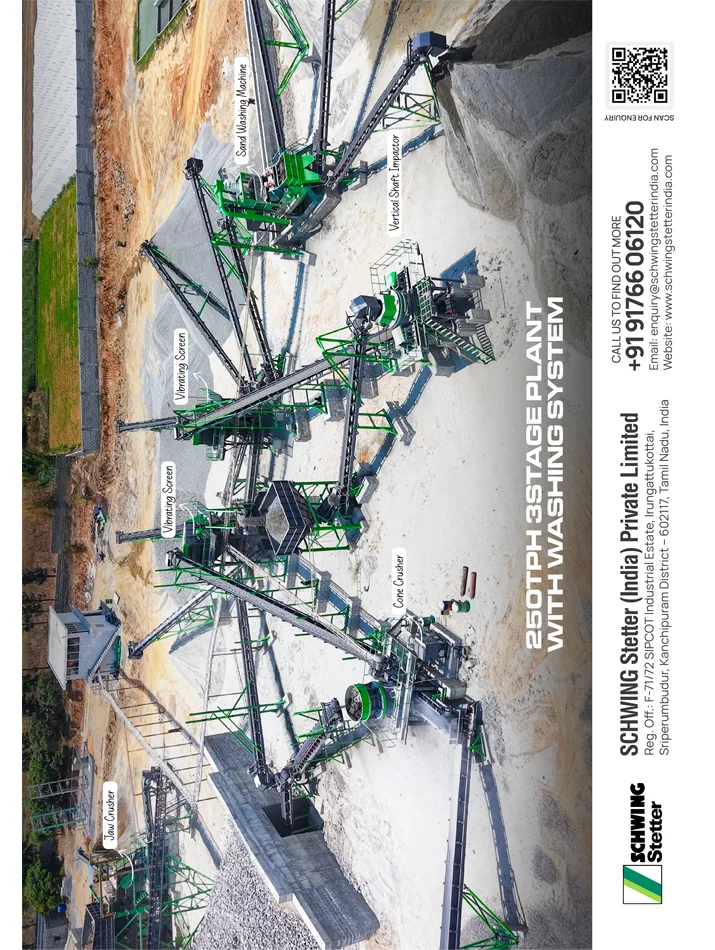
Schwing Stetter India has responded to this trend through a range of track-mounted solutions designed for infrastructure and mining applications. Its Track-Mounted Jaw Crusher combines mobility with high crushing performance, enabling operators to process material efficiently across diverse site conditions. Supporting the machine are the Track-Mounted Cone Crusher and Track-Mounted Screen, which provide efficient secondary crushing and material classification capabilities. Together, these solutions create a flexible processing ecosystem capable of adapting to changing project requirements.
Pralcka’s Wheeled Jaw Crusher further highlights the industry’s move toward mobility. Designed for rapid deployment and relocation, the machine enables contractors to maximize equipment utilization across multiple project sites without compromising on crushing performance. As project schedules become increasingly compressed, such flexibility is becoming a significant competitive advantage.
Among global manufacturers, Kleemann continues to push the boundaries of mobile crushing technology. Its MOBIREX MR 100(i) NEO impact crusher has been developed for recycling and quarrying applications, combining compact dimensions with high productivity and operational versatility. Particularly significant is the MR 100(i) NEOe, an all-electric variant that aligns with the industry’s growing emphasis on lower emissions and reduced fuel consumption. Complementing the crusher is the MOBISCREEN MSS 502(i) EVO, a mobile screening plant engineered to deliver efficient material classification and high throughput. Advanced machine control technologies automatically optimize operating parameters, enabling operators to achieve higher productivity while minimizing fuel consumption and wear.
Indian manufacturers are also strengthening their presence in the mobility segment. Torsa’s Nomad Series and mobile crushing plants provide operators with flexible processing solutions suitable for quarrying, mining, and infrastructure applications. The company’s emphasis on indigenous engineering and localized manufacturing is helping it address the growing demand for cost-effective mobile equipment. Similarly, Indus Crusher continues to expand its range of track-mounted crushing and screening systems, offering customers greater flexibility and operational efficiency in dynamic project environments.
Digital Intelligence Takes Centre Stage
Perhaps the most transformative trend shaping the crushing and screening industry today is digitalization. Advanced automation, connectivity, predictive analytics, and artificial intelligence are enabling operators to move beyond reactive management practices toward data-driven decision-making and predictive maintenance strategies.
Sandvik remains at the forefront of this transformation through its advanced automation and connected crushing technologies. The company’s enhanced CH830i cone crusher incorporates intelligent controls and connectivity features that optimize crushing efficiency, improve liner utilization, and increase operational uptime. Sandvik’s SAM digital platform further extends these capabilities by providing real-time insights into machine performance, production metrics, and maintenance requirements. Operators can leverage this data to identify inefficiencies, predict component wear, and schedule maintenance interventions before failures occur. The result is improved productivity, reduced downtime, and lower lifecycle costs.
Terex India is also leveraging digital innovation through its Terex Connect platform. Designed to provide real-time fleet visibility, machine health monitoring, predictive maintenance alerts, and operational analytics, the system enables customers to optimize equipment utilization and improve asset management. Terex’s growing use of artificial intelligence for lifecycle performance management reflects a broader industry shift toward predictive maintenance models that enhance reliability while reducing operating expenses.
Digitalization is also becoming increasingly prevalent among Indian manufacturers. Hailstone’s Smart Plant Automation System enables centralized control and monitoring of entire crushing and screening operations, helping customers improve efficiency and process consistency. Likewise, Pralcka’s Smart GT Cone Crusher incorporates intelligent monitoring technologies that provide enhanced operational visibility and support data-driven performance optimization. As processing plants become increasingly connected, digital technologies are emerging as a critical differentiator, enabling operators to achieve greater productivity, reliability, and transparency than ever before.
Sustainability Becomes a Competitive Advantage
Environmental performance is rapidly becoming a key purchasing criterion for crushing and screening equipment. As regulations become more stringent and customers place greater emphasis on responsible resource utilization, manufacturers are investing heavily in technologies that reduce emissions, conserve resources, and improve workplace safety.
Puzzolana is addressing one of the industry’s most persistent challenges through advanced dust suppression technologies. By utilizing strategically positioned spray systems and optimized water management techniques, these solutions significantly reduce airborne particulate emissions, improving environmental compliance and workplace conditions. Effective dust control also contributes to lower equipment wear and improved plant performance, demonstrating how sustainability initiatives can generate operational benefits.
Propel Industries is advancing sustainability through its ProWash systems, which are designed to maximize fines recovery while reducing water consumption. Efficient water management is becoming increasingly important as aggregate producers face growing pressure to optimize resource utilization and minimize environmental impact. By improving material recovery and reducing waste, washing technologies are helping operators achieve both environmental and economic objectives.
Kleemann’s all-electric MOBIREX MR 100(i) NEOe further illustrates the industry’s move toward lower-emission equipment. As electrification gains momentum across the construction and mining sectors, machines capable of reducing fuel consumption and carbon emissions are expected to play an increasingly important role in future crushing operations.
Rise of Indigenous Manufacturing
One of the most significant developments in the Indian crushing and screening industry is the emergence of a strong domestic manufacturing ecosystem. Indian OEMs are increasingly investing in research and development, product innovation, automation, and advanced manufacturing capabilities, enabling them to compete effectively with established global brands.
Torsa has strengthened its position through the development of its first indigenously engineered cone crusher, representing a major milestone in localized design and manufacturing. The achievement reflects the company’s broader commitment to developing technologies tailored to Indian operating conditions while reducing reliance on imported equipment.
Companies such as Propel, Puzzolana, Pralcka, Hailstone, Indus Crusher, and Marsman India are also investing heavily in product development and manufacturing capabilities. Their portfolios now encompass advanced crushing, screening, washing, and material handling solutions that address the evolving requirements of quarrying, mining, and infrastructure projects. Increasingly, these companies are focusing not only on domestic opportunities but also on export markets, demonstrating the growing maturity and competitiveness of India’s material processing equipment sector.
The emphasis on indigenous innovation is creating a stronger and more resilient industry while supporting the broader objectives of manufacturing self-reliance and export growth. As Indian manufacturers continue to expand their technological capabilities, they are increasingly positioned to play a larger role in shaping the future of the global crushing and screening market.
The innovations being introduced across the crushing and screening sector highlight a fundamental transformation in how material processing equipment is designed, deployed, and managed. Productivity remains paramount, but it is now accompanied by demands for mobility, intelligence, sustainability, and lifecycle value. Whether through integrated processing plants, advanced mobile equipment, digital monitoring platforms, or environmentally responsible technologies, manufacturers are redefining industry benchmarks and equipping customers with the tools needed to meet the challenges of an increasingly complex and competitive operating environment. The next generation of crushing and screening equipment is not simply more powerful—it is smarter, more connected, and better prepared for the future.
Beyond Machines: The Forces Reshaping the Industry
The future of crushing and screening will be shaped not merely by faster machines or larger plants, but by a fundamental rethinking of how materials are processed, managed, and valued. Across mining, quarrying, infrastructure, and recycling applications, operators are navigating a rapidly evolving landscape marked by rising operating costs, resource constraints, sustainability mandates, labour challenges, and growing pressure to deliver more with less. The result is a decisive shift in priorities—one that is redefining investment decisions, operational strategies, and the very role crushing and screening equipment plays within the broader materials value chain.
Productivity Takes Priority Over Capacity: For decades, growth in the crushing and screening industry was closely tied to a straightforward objective: process more tonnes. Today, however, the conversation has evolved. Producers are increasingly focused on maximizing productivity across the entire processing ecosystem rather than simply increasing plant capacity. Metrics such as uptime, plant utilization, material recovery, process efficiency, and operating costs are becoming just as important as throughput.
This shift reflects a broader recognition that profitability is determined not only by how much material is processed, but by how effectively resources are utilized throughout the operation. Whether in a quarry, mine, or aggregate processing plant, operators are under increasing pressure to eliminate bottlenecks, reduce downtime, optimize material flow, and improve the consistency of end products. Consequently, equipment is being evaluated less as an isolated asset and more as a contributor to overall plant performance. The industry’s focus is moving beyond volume towards value creation, where every tonne processed must deliver maximum economic return.
The Rise of Data-Driven Decision Making: Perhaps the most profound transformation underway is the growing influence of data on operational decision-making. Crushing and screening plants are steadily evolving into connected production environments where machine performance, material movement, maintenance requirements, and production metrics can be monitored and analyzed in real time.
Data is rapidly emerging as a strategic asset. Operators are increasingly leveraging analytics to identify inefficiencies, anticipate maintenance needs, optimize production schedules, and improve asset utilization. The result is a gradual but significant transition from reactive management practices to predictive, performance-driven operating models.
This evolution is changing how processing plants are managed. Decisions that once relied heavily on experience and manual observation are increasingly being informed by actionable insights generated through sensors, telematics platforms, and intelligent monitoring systems. In the years ahead, competitive advantage may depend as much on an operator’s ability to interpret and act on data as it does on the capabilities of the equipment itself.
Resource Efficiency Becomes a Business Imperative: Resource efficiency is emerging as one of the defining priorities of the modern crushing and screening industry. Escalating fuel prices, rising energy costs, increasing water scarcity, and growing pressure to reduce waste are compelling operators to rethink conventional approaches to material processing. As a result, technologies and operational strategies that improve recovery rates, reduce energy consumption, optimize water usage, and extend component life are attracting increasing attention. What was once viewed primarily through the lens of environmental stewardship is now recognized as a powerful driver of productivity and profitability.
The emphasis on resource efficiency is influencing decisions across the value chain, from equipment selection and plant design to maintenance strategies and process optimization. Operators are seeking solutions that enable them to extract greater value from every tonne of material while minimizing resource consumption. In an increasingly competitive market, efficiency is no longer simply about reducing costs—it is about strengthening long-term operational resilience.
Recycling Moves Into the Mainstream: Another significant shift is the growing role of recycling within the construction materials ecosystem. Traditionally, crushing and screening operations have focused predominantly on virgin aggregates and mined resources. Today, however, construction and demolition waste is increasingly being viewed as a valuable secondary resource capable of supporting future infrastructure development. Governments, developers, and contractors are placing greater emphasis on circular economy principles, driving demand for recycled aggregates and recovered materials. This evolution is expanding the scope of crushing and screening beyond conventional quarrying and mining applications and creating new opportunities across urban infrastructure and redevelopment projects.
The implications extend beyond sustainability. Recycling offers the potential to reduce dependence on natural resources, lower transportation requirements, and improve material availability in densely populated regions. As cities continue to expand and environmental expectations become more stringent, recycled materials are expected to play an increasingly important role in the construction value chain, positioning recycling as one of the industry’s most promising growth segments.
Regional Manufacturing Gains Momentum: The final force reshaping the industry is the growing importance of regional manufacturing and localized supply chains. Recent years have underscored the vulnerabilities associated with highly globalized sourcing models, prompting manufacturers and customers alike to place greater value on supply chain resilience, local support, and market responsiveness.
In response, equipment manufacturers are investing in regional production facilities, localized engineering capabilities, and stronger domestic supplier ecosystems. This trend is particularly evident in markets such as India, where indigenous manufacturers are steadily expanding their technological capabilities and strengthening their competitive position.
No longer competing solely on cost, many domestic players are investing in research and development, automation, advanced manufacturing, and product innovation. The result is a more dynamic industry landscape in which locally engineered solutions are increasingly capable of meeting global performance standards while addressing the unique requirements of regional markets. This growing emphasis on localization is not only enhancing supply chain resilience but also fostering innovation, employment, and long-term industrial competitiveness.
Looking Ahead
The crushing and screening industry is entering a period of far-reaching transformation. While advancements in machine design and processing technologies will continue to drive progress, the forces shaping the sector extend well beyond equipment alone. Productivity optimization, data-led decision-making, resource efficiency, recycling, and localized manufacturing are emerging as the defining themes of the next decade. Together, they are reshaping how material processing operations are conceived, managed, and optimized, laying the foundation for a future that is not only more productive and efficient, but also more resilient and sustainable.
Fast Facts
- Global crushing, screening & mineral processing equipment market, valued at approx. US$24.8 billion in 2025, is projected to reach nearly US$36 billion by 2034.
- India crushing & screening equipment market valued at approximately US$532 million in 2025, is expected to reach US$1.56 billion by 2034 at a CAGR of 11.5%.
- India targets 100+ multimodal logistics parks, industrial corridors, expressways, metro projects, and airport expansions, creating sustained demand for aggregates and processed materials.
- Construction & demolition waste recycling is emerging as one of the fastest-growing application areas for crushing and screening equipment globally.
- AI-enabled monitoring, predictive maintenance, electrified crushers, mobile plants, and intelligent process controls are becoming standard features in next-generation equipment.