
RMC: Built to Flow
Construction has entered an era of scale and unforgiving precision. Schedules are tighter, margins for error are shrinking, and concrete is no longer just a raw material—it is the heartbeat that dictates the operating rhythm of a project. Ready-Mix Concrete (RMC) sits at the center of this shift, evolving from a simple supplier into an integrated ecosystem. Moving production to automated batching plants brings vital consistency to quality and speed. Yet the true revolution extends further: connected transit mixers, advanced pumps, and digital logistics now form a seamless chain from batch to build. Equipment no longer merely supports execution; it actively determines its speed and accuracy. As infrastructure and urbanization accelerate across markets, the industry’s defining opportunity is changing. The future is no longer simply about producing more concrete, but about how intelligently it can be produced, transported, and placed…….writes, PRERNA SHARMA.
The shift towards Ready Mix Concrete (RMC) is playing out against a global construction cycle that is expanding in both scale and complexity. Across developed and emerging economies, major infrastructure programmes, urban development, and large commercial and industrial projects are creating sustained demand for dependable, high-volume concrete supply. At the same time, the move towards more controlled, specification-driven construction practices is strengthening the role of organized RMC producers and the equipment ecosystem surrounding them. The market is growing not only because more concrete is being consumed, but because the way it is produced, transported, and placed is fundamentally changing.
That operational change is directly reflected in global market projections. Fortune Business Insights estimates the global RMC market at $1.08 trillion in 2025, with the market projected to reach $2.39 trillion by 2034, representing a CAGR of 9.1%. Asia Pacific accounted for 36% of global revenue in 2025, driven by massive public works and rapid urban expansion.
The geography of that growth is particularly significant. Asia Pacific remains central to the global RMC story, supported by rapid urbanization, massive transport corridor investments, and accelerating civil engineering projects. These large-scale developments are raising the technical bar for concrete supply, placing greater emphasis on batch consistency, strict delivery reliability, and high production efficiency. This environment is creating room for increasingly sophisticated batching systems, higher-productivity transit mixers, advanced high-pressure pumping equipment, and connected fleet telematics. The market is consequently evolving on two distinct fronts: overall demand for concrete is increasing, while the technology and machinery used to manufacture and deliver it are becoming far more sophisticated.
India: The Scale and Technology Convergence
Within this regional narrative, India is emerging as one of the primary markets where volume growth and technological transition directly converge. India’s RMC market is entering a significant phase of expansion, underpinned by the sheer breadth of its national construction pipeline. Highways, high-speed rail corridors, metro systems, airports, industrial hubs, and high-density commercial real estate are generating sustained, non-negotiable requirements for factory-certified concrete.
The commercial opportunity is underscored by recent projections from Grand View Research, which estimates India’s RMC market at $71.63 billion in 2025 and forecasts it to reach $140.32 billion by 2030, expanding at a CAGR of 10.1%. This positions India as the fastest-growing regional market in Asia Pacific. The underlying trajectory is unmistakable. India’s construction supercycle is establishing a substantial and increasingly diverse market for organized RMC, extending far beyond Tier-1 metropolitan centers into Tier-2 and Tier-3 urban development corridors.
More importantly, this market transition is reshaping the technical requirements placed on the RMC equipment ecosystem itself. Greater pour volumes and compressed project completion windows dramatically elevate the importance of plant capacity, weighing accuracy, fleet utilization, and pump productivity. For equipment original equipment manufacturers (OEMs), this shift unlocks structural growth opportunities that extend well beyond routine fleet replacement. Demand is pivoting rapidly toward equipment that can deliver higher output with greater batch-to-batch consistency, lower operating costs, and complete digital visibility across the entire concrete lifecycle.
At the batching level, modern computerized PLC and SCADA control consoles, twin-shaft mixers, and real-time microwave moisture probes ensure exact aggregate dosing and water-cement ratio control. In transit, telematics integration and drum rotation sensors allow operators to monitor concrete slump actively, protecting against premature hydration during city transit delays. At the job site, high-pressure trailer pumps and long-reach articulated boom pumps facilitate continuous vertical pours, effectively removing labor bottlenecks on complex high-rise and tunneling projects.
India’s RMC opportunity is therefore intrinsically tied to the ongoing evolution of its heavy equipment landscape. As the construction sector continues to scale, competitive advantage will no longer depend solely on how much concrete a facility can batch, but on how efficiently and reliably the entire journey from batch to build can be managed.
Engineering the Next Generation of RMC
The latest RMC equipment is being shaped by four clear priorities: higher productivity, greater precision, lower operating intensity and more sustainable operation. Product activity through late 2025 and 2026 shows manufacturers moving beyond incremental improvements in capacity, with electrification, intelligent batching, connected equipment, compact designs and multi-functional machines beginning to redefine the concrete cycle. The shift is significant because the equipment is no longer being developed simply to produce or move more concrete; it is being engineered to make the entire journey from batch to pour more efficient, predictable and resource-conscious.
AJAX is pushing RMC equipment towards greater automation, accuracy and productivity, with intelligence increasingly embedded within the machine itself. Its recent portfolio spans self-loading mixers and batching solutions, with a growing emphasis on automated batching, telematics, load-cell technology and digital monitoring. The company’s UDAAN Compact Mixer, introduced at EXCON, brings mechanised concrete production to smaller and space-constrained sites, combining self-loading and mixing in a compact platform with a 0.8 m³ drum output per batch. At the larger end, AJAX’s high-capacity batching solutions are designed to support higher-volume infrastructure requirements, while its connected technologies seek to improve weighing accuracy, machine utilisation and operational visibility. The broader direction is towards equipment that delivers greater productivity with tighter control over material, fuel and machine performance—an increasingly important proposition as RMC operations move towards more data-led management.
Putzmeister is taking the sustainability conversation beyond individual machines, with its iONTRON platform bringing electric power into both concrete transportation and pumping. The standout development is the iONTRON eBSF 42-5, described by Putzmeister as the world’s first fully electric truck-mounted concrete pump with a 42-metre distribution boom. The machine combines electric driving with electric support, boom movement and pumping, and can deliver concrete at up to 150 m³/h. Its significance extends beyond the machine itself: electric operation can reduce local emissions and noise while opening new possibilities for concrete work in urban and environmentally sensitive locations. The iONTRON portfolio also includes the P9 G electric truck mixer with a 9 m³ mixing drum, taking electrification into concrete transportation. The development has begun moving into the Indian RMC market as well, with UltraTech announcing the induction of 10 Putzmeister iONTRON electric transit mixers into its RMC operations in 2026. Alongside electrification, Putzmeister is advancing intelligent batching and connected control systems, pointing towards an RMC ecosystem where cleaner power, automation and digital intelligence increasingly work together.
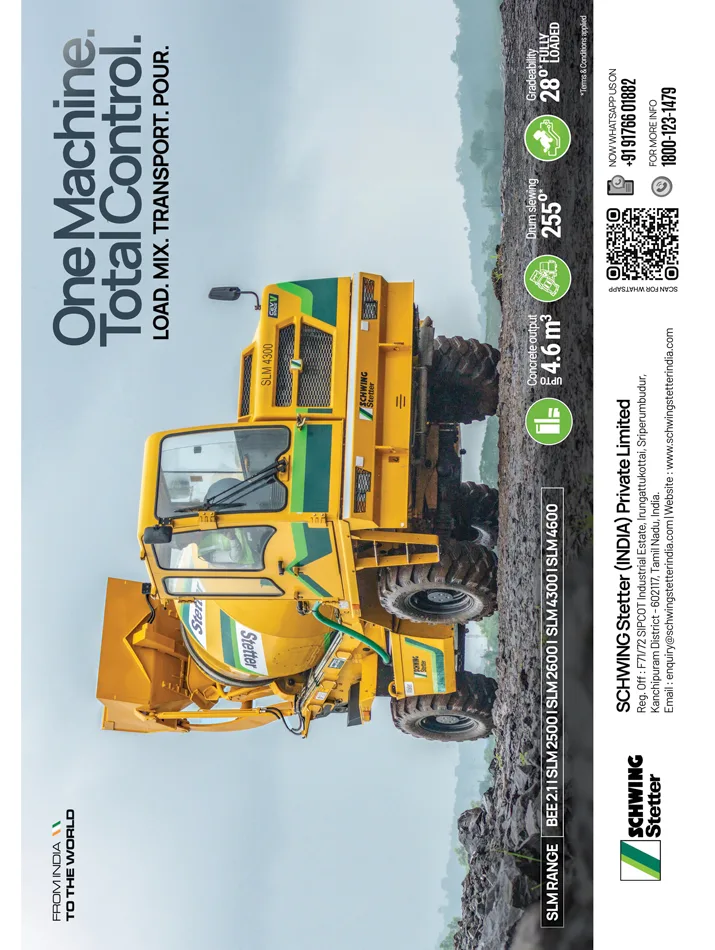
SCHWING Stetter India’s latest RMC portfolio combines productivity, alternative power and equipment integration across batching, mixing and delivery. Its 2026 offering includes the SB 40 Single Belt Conveyor Batching Plant, AM 7 EV Electric Truck Mixer, AM 7 CNG Truck Mixer, SLM 4300 NEU Self-Loading Mixer and FBP 29 Truck Mixer Pump. The SB 40 introduces a single-belt conveyor configuration aimed at simplifying material movement and streamlining plant operation. The AM 7 EV extends electrification into concrete transportation, while the CNG variant provides an alternative powertrain as RMC operators increasingly examine fuel efficiency and emissions. The SLM 4300 NEU combines loading and mixing in a mobile platform, offering flexibility for projects where conventional RMC infrastructure is difficult to establish. The FBP 29, meanwhile, combines concrete mixing and pumping in a single machine, potentially reducing equipment movements and simplifying the path from production to placement. Together, the developments point towards a more flexible RMC fleet, where productivity is measured not only by output but also by how efficiently each machine can contribute to the complete concrete cycle.
Apollo Inffratech is focusing on another critical RMC requirement: achieving higher batching efficiency without unnecessarily increasing the plant footprint or complexity. Its compact batching solutions are designed for applications where space, mobilisation time and operating economics are important considerations, with the company’s ATP range extending across capacities suited to different project scales. Its compact systems incorporate single-belt material handling and automated controls, while larger inline configurations are designed for higher-volume infrastructure and industrial applications. The emphasis is on faster installation, efficient material handling, accurate weighing and greater plant productivity, allowing RMC producers and project contractors to match batching capacity more closely to the requirements of the site. As construction moves into increasingly constrained urban environments, this ability to combine capacity with a smaller operational footprint could become an important differentiator.
Taken together, the latest developments point to a clear evolution in RMC equipment. Electrification is moving into transit mixers and pumps; intelligence is entering batching and machine controls; compact designs are widening the scope for mechanisation; and multi-functional equipment is reducing the number of separate steps between production and placement. The more important shift, however, is the growing emphasis on the performance of the complete system rather than the specification of an individual machine.
The RMC equipment of the next phase will therefore be judged not simply by how much concrete it can produce, transport or pump, but by how intelligently, efficiently and sustainably it can keep the concrete moving.
Global Innovation: Redefining the RMC Value Chain
The next wave of RMC innovation is emerging at the intersection of materials, machinery and data. The global industry is moving towards systems that can respond to changing material conditions, track concrete through its journey and optimise production with far greater precision. At the same time, the concrete itself is changing, with lower-carbon binders, recycled inputs, application-specific mixes and industrialised construction creating new demands on RMC producers and equipment. The definition of efficiency is consequently expanding—from output alone to consistency, resource consumption, delivery reliability, performance and the carbon intensity of every cubic metre.
One of the clearest signals is the arrival of AI inside the batching process. Command Alkon’s Batch AI, recognised in the 2026 World of Concrete Innovative Product Awards, analyses variables including material moisture, temperature, equipment behaviour and load size to dynamically optimise batching. Reported deployments have shown improvements in in-tolerance batching from 86% to 97% and a reduction in cement overuse from 9% to 2%. The significance is larger than automation alone: AI is beginning to make batching a continuously optimising process, with quality, material efficiency and cost increasingly addressed together.
That intelligence is also moving onto the road. Saint-Gobain’s Verifi Pulse, launched in 2026, captures workability, temperature, mixer activity, water additions and truck location, creating real-time visibility into concrete while it is being transported. Saint-Gobain says Verifi technology has already tracked approximately 172 million m³ of concrete worldwide. Cloud Cycle is similarly using sensors on mixer trucks to monitor slump, temperature, drum speed and water addition, with its technology deployed on more than 500 trucks across nine countries by 2026. The implication is significant for RMC operators: the period between batching and placement, traditionally difficult to monitor, is becoming a measurable part of the production process.
But technology is only one part of the change. The concrete itself is becoming more sophisticated. Around the world, producers are increasing the use of supplementary cementitious materials, recycled inputs and alternative binders, reducing reliance on conventional clinker-intensive formulations. At the same time, high-performance, self-compacting, ultra-high-performance and other specialised concretes are being developed around specific structural and placement requirements. This is moving RMC away from standard recipes towards performance-based mix design, requiring greater dosing precision and equipment capable of handling a broader range of materials and admixtures.
That shift is also bringing carbon into the specification. As Environmental Product Declarations, embodied-carbon calculations and project-level carbon targets gain importance, the carbon intensity of a cubic metre of concrete is increasingly becoming another performance attribute alongside strength, durability and cost. For RMC producers, this creates a new basis for differentiation—and for equipment manufacturers, a need to support increasingly precise material management.
Plant architecture is changing alongside these developments. Liebherr’s Mobilmix 4.0, unveiled at bauma 2025, uses modular construction to support flexible configurations, faster assembly and easier deployment, while its LiPerformance system is designed to improve production efficiency and resource utilisation. The proposition becomes particularly relevant as RMC increasingly serves projects with different locations, durations and capacity requirements. Instead of treating a batching plant as a fixed piece of infrastructure, modularity allows producers to think of capacity as something that can be configured around the project.
The move towards industrialised construction strengthens this requirement further. Precast, modular and prefabricated construction demand highly consistent concrete production across repeated cycles, while allowing less room for variation in material performance. RMC plants will consequently need to combine flexibility with repeatability—switching between formulations while maintaining tight control over every batch.
The transformation is reaching even further upstream into mix design itself. Meta’s 2026 BOxCrete model applies Bayesian optimisation to concrete formulations, balancing strength, workability, cost and sustainability while helping identify more efficient combinations of cementitious materials, aggregates, water and admixtures. For an industry where cement remains a major source of embodied carbon, better mix design can become both a productivity and decarbonisation lever.
Circularity is adding another layer. Recycled aggregates, recovered water and industrial by-products are increasingly finding their way into concrete where standards and performance requirements permit. But greater material diversity brings greater variability, making process control even more important. The ability to consistently work with alternative inputs could become a competitive capability for the next generation of RMC plants.
Another frontier is emerging at the intersection of RMC, automation and advanced construction methods. AI-powered 3D concrete printing is beginning to connect material formulation, equipment movement and structural design into a single digital process. While the technology still faces challenges around material behaviour, process control and structural performance, its evolution points towards a future in which concrete is not simply produced and delivered, but digitally formulated and precisely placed according to the geometry of the structure itself.
Together, these developments are changing the nature of the RMC operation. The batching plant, mixer truck, quality system, mix-design platform and project site are gradually becoming parts of one connected production chain. The future opportunity lies not simply in making individual machines smarter, but in allowing information to move as efficiently as the concrete itself—from material selection and batching to transportation, placement and performance. And that could become the defining shift in RMC: from a business built around moving concrete to one increasingly built around controlling its flow, quality, resource intensity and performance from beginning to end.
Building the Future of RMC
The future of RMC will be shaped less by any single breakthrough than by how effectively different technologies and capabilities come together. As construction becomes more urban, projects more complex and sustainability requirements more demanding, RMC producers will need to deliver concrete that is not only consistent and cost-effective, but increasingly measurable in terms of performance, resource use and carbon intensity.
This will place new demands on equipment. Batching plants will need greater flexibility to work with changing material combinations. Transit mixers will become increasingly connected to the production and delivery network. Pumps will need to handle more specialised mixes with greater precision. And digital platforms will increasingly connect the information generated across these stages, allowing producers to see where time, material, energy and capacity are being lost—and where they can be recovered.
The economics will matter just as much as the technology. Higher utilisation, lower downtime, reduced material wastage and greater predictability will become central to equipment decisions. The most valuable machine may not necessarily be the one with the highest capacity, but the one that delivers the strongest combination of productivity, reliability, energy efficiency and lifecycle economics.
There is also a larger opportunity emerging around urban construction. As cities become denser and project sites more constrained, compact equipment, electric mobility, quieter operations and highly controlled concrete placement will become increasingly relevant. RMC equipment will have to adapt to construction environments where space, access, emissions and operating hours are all under greater scrutiny.
At the same time, the boundaries between the RMC producer, equipment manufacturer, material supplier and technology provider are likely to become less distinct. Partnerships such as those emerging around electric equipment, digital quality platforms, AI-enabled mix design and connected fleets point towards an ecosystem in which innovation increasingly happens across companies rather than within a single product category.
For India, the opportunity is particularly significant. A sustained infrastructure pipeline, urbanisation and the expansion of organised construction create room for RMC penetration to deepen, while the country’s growing manufacturing capabilities can support the development of equipment not only for domestic demand but also for global markets. The next phase will require scale—but also greater sophistication in how that scale is delivered.
Ultimately, the evolution of RMC equipment is moving towards a simple but consequential proposition: more intelligence in every batch, more efficiency in every movement and more value in every cubic metre. The concrete industry has always been about getting the right material to the right place at the right time. The future will add another dimension—knowing, in real time, exactly how that material is performing and how efficiently the entire system is working. And that is where RMC is headed: from ready-mix concrete to increasingly ready-to-respond concrete systems—built to flow with the demands of the infrastructure of tomorrow.
Fast Facts
- The global RMC market is estimated at 5.83 billion m³ in 2026, rising to 7.36 billion m³ by 2031, reflecting a 4.78% CAGR over the period.
- Asia-Pacific accounted for 77.12% of global RMC volume in 2025, highlighting the region’s dominant role in the industry’s next phase of expansion.
- India’s RMC market is estimated to grow from 249.14 million m³ in 2025 to 266.26 million m³ in 2026, reflecting the country’s expanding demand for organised concrete production.
- Transit-mix concrete accounted for 70.40% of India’s RMC market volume in 2025, highlighting the growing importance of mixer-truck capacity and fleet efficiency.
- RMC accounted for 55.13% of the global concrete market in 2025, underscoring the growing importance of factory-produced concrete in modern construction.