
Our strategy is to evolve from being primarily a concrete-equipment specialist into a broader infrastructure equipment and technology partner
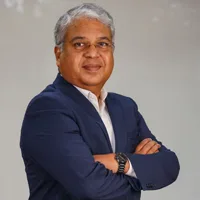
SCHWING Stetter India known for launching innovative products has expanded its footprint in untapped regions, solidifying its leadership in the CE space. In an exclusive interview to CONSTRUCTION OPPORTUNITIES, V. G. SAKTHIKUMAR, CMD, SCHWING STETTER INDIA, gives an overview of the range of equipment and solutions to be showcased at BAUMA CONEXPO INDIA, aftermarket services and a lot more.
What key products, technologies, or launches will you be showcasing at BAUMA CONEXPO INDIA 2026, and how do these offerings address the evolving needs of construction, mining, and infrastructure segments such as bridges, flyovers, rural projects and smart cities?
At BAUMA CONEXPO INDIA 2026, SCHWING Stetter India will present a broad spectrum of concrete and construction equipment, including close to five new products along with new-generation versions and configurations.
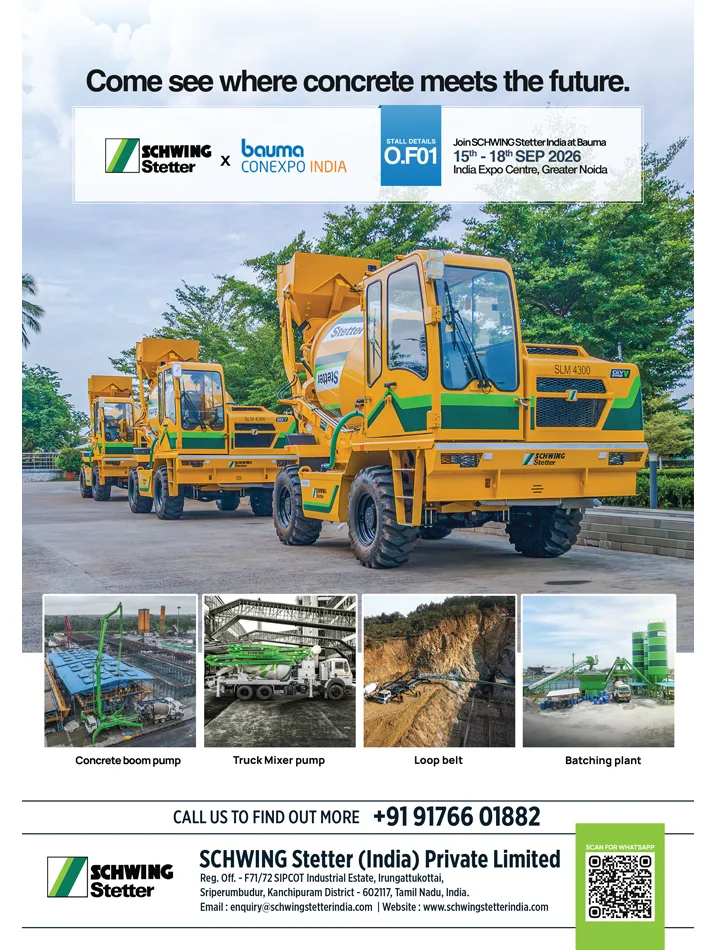
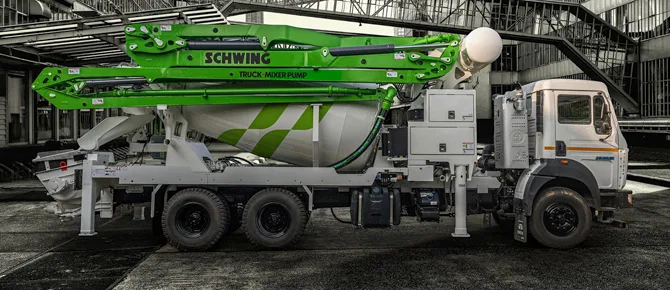
Our showcase will cover batching plants, truck mixers, concrete pumps and boom pumps, self-loading mixers, recycling solutions and crushing equipment, supported by intelligent controls, telematics and advanced diagnostics.
The focus is on matching equipment to applications. High-capacity batching and long-reach pumping solutions support bridges, flyovers, metros and large infrastructure, while compact batching plants and self-loading mixers provide mobility and flexibility for rural and dispersed projects.
For urban and smart-city applications, compact equipment, alternative-power solutions and recycling technologies can help improve productivity while reducing site congestion and environmental impact.
Please provide details on your emphasis on technology, research, design and innovation. What is your focus on technological upgradation in respect of digitalisation, automation, AI, telematics and predictive technologies?
Technology has moved from being an additional feature to becoming an integral part of machine performance. Our R&D; efforts increasingly combine mechanical engineering with automation, intelligent controls, IoT, telematics, diagnostics and data-driven machine management.
We are working towards equipment that can tell the customer more about its own performance – production, utilisation, fuel or energy consumption, service requirements and potential abnormalities. The direction is towards greater predictive capability and progressively more automated operation. Our objective is practical: higher output, safer operation, reduced downtime and better lifecycle value rather than adding technology simply for the sake of technology.
This direction is also being supported by our R&D; and Global Capability Centre in Chennai.
Tell us about the indigenisation efforts undertaken by the company to meet market requirements. What is the company’s approach to implementing the ‘Make in India’ drive?
Localisation has been central to SCHWING Stetter India’s growth strategy. We have progressively expanded local engineering, manufacturing and vendor development so that products designed to global standards are also optimised for Indian operating conditions and cost structures.
The recent Jamshedpur manufacturing facility for truck mixers takes this strategy further. The first fully built SCHWING Truck Mixer on a Tata chassis rolled out from the facility in August 2026, and we are now working towards deeper localisation by developing the surrounding vendor ecosystem.
For us, Make in India goes beyond assembly. It means designing, engineering, sourcing and manufacturing more in India, building supplier capability and progressively using India as a manufacturing base for both domestic and export opportunities.
How does your organisation ensure strong aftermarket support, customer service and high uptime for its equipment across diverse and demanding operating conditions?
In construction equipment, the real measure of a machine is not only how it performs when it is new, but how consistently it performs throughout its working life. Therefore, aftermarket support has always been a major pillar of SCHWING Stetter India’s strategy.
Our approach combines a wide service network, trained service engineers, spare-parts availability, preventive maintenance, operator and technician training and increasingly digital diagnostics and remote machine monitoring. For large projects, service planning starts along with equipment deployment. The objective is simple: reach the customer quickly, anticipate problems wherever possible and maximise equipment availability.
What sort of customer-centric initiatives has your company undertaken to be one step ahead of competition?
Many of our product developments have come directly from understanding what customers experience at the jobsite. Customers are asking for more productivity from a smaller footprint, easier operation, lower fuel consumption, faster service
and greater visibility of machine performance.
We therefore work closely with customers right from application engineering and equipment selection to commissioning, operator training and lifecycle support.
Solutions such as compact batching plants, higher-reach boom pumps, self-loading mixers, mixer-pump combinations and digital monitoring reflect this application-led approach. Customer centricity, for us, is ultimately about reducing the customer’s cost per cubic metre and improving the return on equipment.
What is your assessment of the market potential for your key product categories in India, and how do you foresee demand trends evolving in 2027 and beyond?
The medium- and long-term outlook remains positive because India’s infrastructure requirement extends across highways, metros, railways, airports, bridges, industrial projects, urban infrastructure, housing and rural connectivity.
We expect demand to increasingly move towards equipment offering higher productivity, automation and lower lifecycle cost. Large infrastructure will require higher-capacity batching and pumping solutions, while self-loading mixers and compact plants should continue to find strong applications in dispersed and rural construction. Recycling, crushing, precast and alternative-power equipment should also gain importance. Beyond 2027, we expect technology adoption to accelerate as customers increasingly evaluate machines on output, uptime and total cost of ownership, rather than only initial purchase price.
How is your organisation embedding sustainability, cleaner technologies and environmentally responsible practices into its products, operations and long-term strategy?
Sustainability has to deliver both an environmental and an economic benefit to the customer. Our development direction therefore includes electric and hybrid equipment, alternative-fuel solutions, energy-efficient systems, concrete recycling and C&D; waste processing, along with technologies that reduce material wastage.
Recent developments such as the full-electric truck mixer, CNG mixer variant and S36X hybrid boom pump demonstrate this direction. Our concrete recycling solutions allow residual concrete to be recovered and reused, while crushing solutions support greater circularity in construction materials.
The long-term objective is to enable customers to produce and place more concrete with lower energy consumption, fewer emissions and better utilisation of materials.
Rentals are growing. What is your strategy to tap opportunities and outlook for the rentals market?
Rentals will become increasingly important as contractors seek to remain asset-light and access specialised equipment according to project requirements.
This is particularly relevant for boom pumps, concrete pumps, self-loading mixers and other equipment where utilisation can vary from project to project.
For an OEM, the rental market also creates a different requirement. Machines must be rugged, versatile, easy to operate and maintain, and supported by strong service and spare-parts availability. We see rental companies becoming more professional and increasingly evaluating equipment on utilisation, residual value and lifecycle economics. We intend to support this ecosystem through the right product configurations, training, service and technology.
Your company has been exhibiting at BAUMA CONEXPO INDIA. How has the exhibition evolved? As an exhibitor, what have been the major takeaways?
BAUMA CONEXPO INDIA has evolved from being predominantly a product exhibition into an important technology, customer-engagement and industry networking platform. Customers today come to the exhibition not simply to see a machine but to understand automation, digitalisation, sustainability, productivity and the economics behind new technologies.
For SCHWING Stetter India, the exhibition provides an opportunity to meet customers from across the country at one location, demonstrate technologies in a practical environment and receive direct feedback from contractors, RMC producers, infrastructure developers and equipment owners. It also gives us a valuable understanding of where the industry is heading. The quality of customer interaction and technology discussions has increased significantly over the years.
What is your outlook for the construction equipment industry and your company going forward?
India is entering a phase where infrastructure development will increasingly demand speed, scale, quality and technology simultaneously. This creates a strong long-term opportunity for the construction-equipment industry.
At SCHWING Stetter India, our strategy is to evolve from being primarily a concrete-equipment specialist into a broader infrastructure equipment and technology partner, while retaining our core strength in concreting. We will continue investing in localisation, R&D, digitalisation, alternative-power technologies, manufacturing capacity, customer support and skill development.
Our objective going forward is straightforward: build more products in India, develop more technology in India and support customers throughout the equipment lifecycle, while progressively strengthening India’s role within SCHWING’s global manufacturing and engineering network.