

At FEHM, crane rental is a business we intend to scale aggressively but responsibly

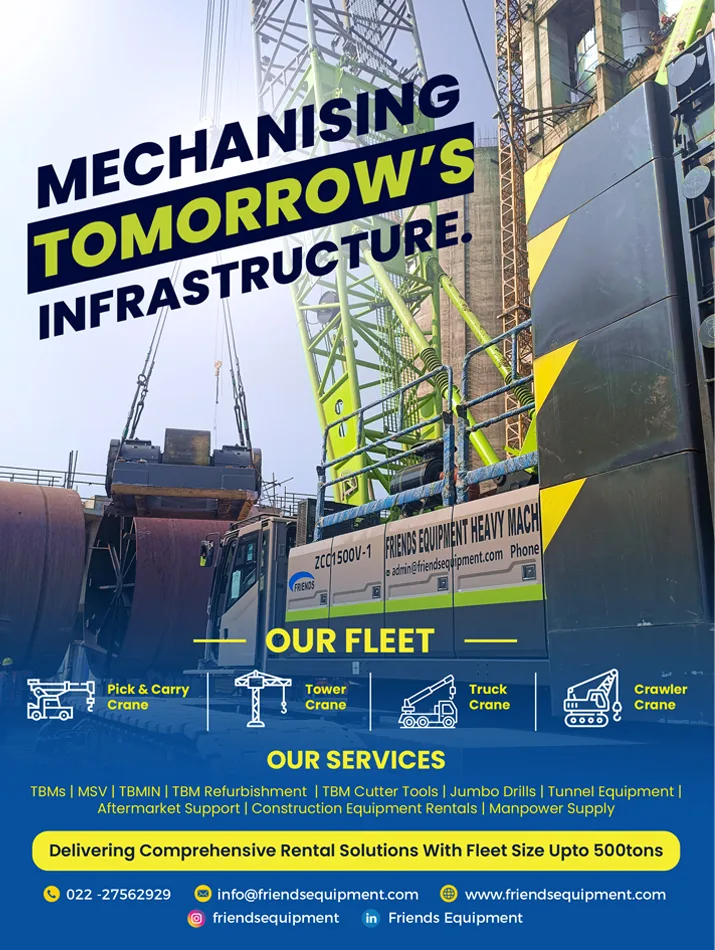
Friends Equipment Heavy Machinery (FEHM), provides pick-and-carry cranes, tower cranes, truck-mounted cranes, crawler cranes and other specialised lifting equipment on a rental basis with capacities currently ranging from around 20 tonnes to 500 tonnes and continuously expanding. The company is today a vital and trusted partner for customers in construction, industrial, power plants, petrochemical, refineries, mining, cement plants manufacturing and other businesses across India by providing integrated consulting solutions, timely rentals, maintenance, service, and sales of new and used equipment and spare parts. In an exclusive interview to CONSTRUCTION OPPORTUNITIES, KANWAR ABHAY SINGH, DIRECTOR, FRIENDS EQUIPMENT HEAVY MACHINERY PVT. LTD., provides an overview on India’s crane rental industry, his company’s offerings, customer centric initiatives and a lot more.
Give a brief overview of the Cranes Rentals industry in India, latest trends and market dynamics.
India’s crane rental industry is witnessing strong growth, supported by continued investments in infrastructure, metro and rail projects, renewable energy, industrial construction and urban development. We are also seeing contractors increasingly prefer renting over owning equipment, allowing them to remain asset-light and select cranes according to project-specific requirements.
From a fleet owner’s perspective, the market is gradually shifting towards higher-capacity, newer and safer equipment. At the same time, rising equipment, finance, maintenance and manpower costs are putting pressure on rental margins. Going forward, success will depend not just on fleet size, but on utilisation, reliability, safety and the ability to mobilise the right equipment quickly.
Tell us of your various crane offerings, their lifting capacities, applications and demand in the Indian market.
At FEHM, we have built a fairly diverse fleet comprising pick-and-carry cranes, tower cranes, truck-mounted cranes, crawler cranes and other specialised lifting equipment, with capacities currently ranging from around 20 tonnes to 500 tonnes and continuously expanding.
Our equipment is deployed across infrastructure, industrial construction, metro and tunnelling projects, heavy erection and high-rise construction. We are seeing particularly good demand for higher-capacity and specialised equipment as projects become larger and execution timelines become tighter. Our focus is to keep expanding the fleet in line with where we see actual demand rather than simply adding numbers.
Please provide details on your emphasis on technology – features like intelligent crane control systems and digital platforms imbibed in your cranes and innovations? What are the advancements you have introduced or plan to introduce?
Technology is becoming increasingly important in the rental business. Since a large part of our fleet consists of newer-generation machines, we already benefit from modern safety and monitoring systems offered by the OEMs.
Going forward, our bigger focus is on using technology at the fleet-management level – GPS and equipment tracking, monitoring utilisation, preventive maintenance, service records and better visibility of machines across different projects. For us, technology should ultimately help achieve three things: better safety, higher utilisation and lower downtime.
Detail us on your USPs.
I would say our biggest USP is that we don’t approach rental as simply supplying a crane. We first understand the client’s lifting requirement, site conditions and project duration and then recommend the right machine for the job.
We also maintain a relatively young fleet, which gives clients greater reliability and reduces downtime. Another major strength is our operating team. We are very particular about operator selection and prefer experienced, reference-backed people. Many members of our crew have been associated with us for several years, so we know their capabilities and can confidently back their experience on site.
How does your organisation ensure strong aftermarket support, customer service and high uptime for its equipment across diverse and demanding operating conditions?
Keeping equipment running is ultimately the backbone of a rental business. A major advantage for us is that most of our equipment is relatively new, which itself substantially reduces breakdowns and downtime.
Preventive and major maintenance is carried out through OEM-approved procedures and partners. At the same time, we have an experienced in-house service team, including professionals with more than 25 years of experience. This combination allows us to respond quickly on site while ensuring that the equipment is maintained to the right standards.
What sort of customer-centric initiatives has your company undertaken to be one step ahead of competition?
For us, customer service starts before the crane reaches the site. We try to understand the lift, working radius, site constraints and duration so that the customer gets the right equipment rather than simply what is available.
Once deployed, our focus is on quick response, preventive maintenance and minimising downtime. We are also increasingly looking at long-term relationships rather than individual rental orders. If a customer is executing multiple projects, we want FEHM to become the first call whenever there is a lifting requirement.
What are the emerging trends in crane rentals? To what extent is consumer behaviour influenced by cost? What is your strategy in this price-sensitive market?
India is definitely a price-sensitive market, and rental rates will always matter. But with larger and more time-bound projects, customers are increasingly looking beyond the lowest rate. Reliability, machine age, safety, operator quality and response time have become equally important. A crane that is slightly cheaper but remains down for two days can ultimately cost the project much more than the saving in rental. Our strategy, therefore, is not to be the cheapest player in the market. We want to provide the customer with the right machine, dependable uptime and professional support at a competitive price.
Detail us about the steps initiated to upgrade the skill sets of technicians and operators.
We regularly encourage OEM-led training for our operators and technical teams, particularly when new machines or technologies are introduced into the fleet.
At the same time, a lot of learning happens through experience on different project sites. We have several experienced operators and technicians within the organisation, and we encourage that knowledge to be passed on to the younger team members. As machines become more sophisticated, continuous training is going to become even more important.
Tell us about the new products you have launched or plan to launch in the near future.
We have recently added a 32-tonne tower crane along with multiple higher-tonnage cranes to our fleet. Looking at the project pipeline and the direction in which the market is moving, we plan to grow our fleet by approximately 15–20% year-on-year, with greater emphasis on heavy-tonnage and specialised lifting equipment. We are not looking at expansion purely in terms of the number of cranes; the objective is to build a balanced fleet that can cater to increasingly complex lifting requirements.
What sort of government policies or measures will foster growth for the infrastructure industry at large and thereby propel the growth of the crane industry?
The biggest support for our industry is continuity in infrastructure spending and, more importantly, timely execution of those projects. Roads, metros, railways, ports, renewable energy, industrial projects and urban infrastructure all directly create demand for lifting equipment.
From a rental company’s perspective, faster project awards and clearances, easier movement of heavy equipment between states and greater emphasis on mechanised and safe construction practices would help the industry significantly. Access to competitive financing is also important because modern cranes require substantial capital investment.
What is your future outlook for the industry and from a company perspective?
I am quite positive about the next few years. India is building infrastructure at a scale where mechanisation is no longer optional, and contractors are increasingly comfortable renting specialised equipment rather than owning every asset themselves.
For FEHM, crane rental is a business we intend to scale aggressively but responsibly. Being a second-generation business, we already have a strong foundation, but my objective is to bring in a more modern approach towards fleet selection, technology, systems and customer service.
We plan to continue adding newer and higher-capacity equipment, enter more specialised lifting applications and expand geographically. The long-term objective is very clear – to build FEHM into one of the most dependable and recognised names in India’s crane rental and heavy-equipment space.