
INDIA THE INFRA GIANT LOADING
India’s infrastructure sector is undergoing a massive transformation, fueled by rapid urbanization, government mega-projects, and cutting-edge technology. At the heart of this evolution is the GenX construction equipment industry, playing a pivotal role in driving efficiency, sustainability, and scale. With flagship programs like PM Gati Shakti, Bharatmala, and Smart Cities Mission, the demand for advanced earthmoving, material handling, and road construction machinery is witnessing massive surge. The industry is witnessing a shift towards automation, IoT-enabled smart machines, and electric/hybrid equipment, ensuring faster project execution. Additionally, the ever-growing sustainability concerns are driving the adoption of fuel-efficient, emission-compliant machinery and alternative fuels like CNG and biofuels. As India gears up for record-breaking infrastructure growth, the construction equipment industry stands at the forefront, powering the nation’s journey toward a modern, connected, and sustainable future….. writes, PRERNA SHARMA.

Nitin Gadkari, Hon’ble Union Minister for Road Transport and Highways, Government of India, was recently quoted as saying, “India is rapidly transforming into a global infrastructure powerhouse with large-scale projects worth Rs70 lakh crore already underway. To sustain this momentum, we must prioritize technological innovation, invest in research & development, and adopt sustainable fuels. The construction equipment industry, being the world’s third largest, has immense potential to expand exports and strengthen India’s manufacturing capabilities. I urge industry leaders to focus on advanced technologies and global partnerships to ensure long-term growth and a greener, more competitive future.” These are the apt words that describe the close connect between the rapid infrastructure development and the era of new age construction equipment.
The wheels of the progress are in the continued momentum with a strong push from the recent Budget announcement. “In her 8th budget, the Honourable Finance Minister presents a strategic vision to propel

India’s economic growth, with a strong focus on infrastructure as a catalyst for the Viksit Bharat @2047. Despite global economic headwinds, India maintains its position as the fastest-growing major economy, with a GDP growth forecast between 6.3% and 6.8%, in line with IMF projections,” shares Neetu Vinayek, Partner & Leader, Infrastructure Sector, Tax & Regulatory Services, EY India.
“The government demonstrates its commitment to infrastructure with an allocation of Rs.11.21 lakh crore, building on the previous year’s Rs.11.11 lakh crore. A new Asset Monetization Plan is set to unlock value from public assets, while a three-year pipeline for PPP projects will encourage private sector engagement,” she adds.
With such impressive developments, India is poised for a transformative year in 2025, with the completion of several key infrastructure projects that promise to significantly enhance connectivity, reduce travel times, and bolster economic growth. Let’s take a look at some of them…
As of February 2025, the Navi Mumbai International Airport (NMIA) is on track to commence operations in the coming months. The airport is scheduled to be inaugurated in April 2025, with domestic flight operations beginning in the second half of May 2025. In December 2024, NMIA successfully conducted a commercial flight validation test, where an IndiGo A320 aircraft landed on runway 08/26, marking a significant milestone toward operational readiness.
Looking ahead, NMIA plans to commence international flight operations in July 2025. By October 2025, approximately 150 flight slots are expected to be relocated from Mumbai’s existing Chhatrapati Shivaji Maharaj International Airport to NMIA, aiming to decongest air traffic in the region. These developments indicate that NMIA is progressing as planned and is poised to enhance aviation capacity in the Mumbai Metropolitan Region significantly.
As per Colliers India report, the upcoming Navi Mumbai International Airport is going to be India’s first airport with multi-modal transport connectivity. This new airport will have the capacity to serve ~9 crore passengers annually and will boost growth around the 90,000 acres of surrounding land, via the NAINA (Navi Mumbai Airport Influence Notified Area). This, in turn, would drive the growth of real estate in the region, with land prices appreciating nearly 3.9 x in next 5 years from Rs4,200 to Rs16,200 per sqft. (2024-2030) in micro markets like Khopoli, Pen. This is backed by the expected sprouting of improved infrastructure, better connectivity, along with opportunities for new residential and commercial developments. These developments are expected to culminate in effectively establishing ‘Third Mumbai’ as a new urban hub in proximity to the airport.
As of February 2025, Mumbai’s Coastal Road Project has made significant progress. The project is an 8-lane, 29.2-km-long expressway along Mumbai’s western coastline, connecting Marine Lines in the south to Kandivali in the north. It aims to reduce travel time between South Mumbai and the western suburbs from 2 hours to approximately 40 minutes. In late January 2025, the North Channel Bridge, a crucial link connecting the Mumbai Coastal Road Project to the Worli-Bandra Sea Link, was inaugurated. The 10.58 km Phase 1, stretching from Marine Drive to the Bandra-Worli Sea Link, is under active construction by the Brihanmumbai Municipal Corporation (BMC). While significant portions of the project are expected to be operational by the end of 2025, full completion, including landscaping and additional features, is anticipated by December 2025. Upon completion, the Coastal Road is projected to accommodate approximately 130,000 vehicles daily, significantly enhancing connectivity and reducing congestion along Mumbai’s western corridor.
As of February 2025, the Noida International Airport, also known as Jewar Airport, is progressing steadily towards its scheduled operational launch in April 2025. Approx. 80% of the terminal construction has been completed, including key components such as the baggage handling system, escalators, and flooring. In its initial phase, the airport is designed to handle 12 million passengers annually, with future expansions planned to accommodate up to 70 million passengers per year.
The development is structured into four phases, with Phase 1 encompassing a 90,000 sqm Terminal 1 building, a 4,150-meter Code ‘E’ runway, a parallel taxiway, an Air Traffic Control (ATC) building, cargo facilities, commercial developments, and provisions for metro and high-speed rail stations. Upon completion, Noida International Airport is expected to significantly enhance connectivity for cities such as Agra, Mathura, and Gautam Buddh Nagar, integrating them into the global aviation network and promoting industrialization in the region.
The Delhi-Mumbai Expressway is partially operational as of early 2025, with significant progress made toward its full completion. Spanning approximately 1,386 kms, the expressway is designed to reduce travel time between Delhi and Mumbai to around 12 hours. The stretch from Sohna in Haryana to Dausa in Rajasthan was inaugurated in February 2023, while the 845km Delhi-Vadodara section became operational in October 2023. By mid-2024, about 82% of the construction work had been completed, covering nearly 1,136 kms. The entire stretch of the Delhi-Mumbai Expressway (DME), which aims to reduce travel time between the financial and political capitals to 12 hours, will only be ready by 2026, minister of state (MoS) for road transport and highways Harsh Malhotra stated. The expressway passes through Haryana, Rajasthan, Madhya Pradesh, Gujarat, and Maharashtra, featuring an eight-lane design with the potential for future expansion to twelve lanes.
As of early 2025, the Bharatmala Pariyojana continues to make significant strides in enhancing India’s road infrastructure. The program, initiated in 2017, aims to develop approximately 34,800kms of national highways under its first phase. By October 31, 2024, about 18,714 kms had been completed, reflecting substantial progress toward the project’s goals. The total expenditure incurred by the National Highways Authority of India (NHAI) under the Bharatmala Pariyojana reached ?4.72 lakh crore by November 30, 2024. This investment underscores the government’s commitment to improving connectivity across the nation. Looking ahead, the Ministry of Road Transport and Highways’ Vision 2047 aims to provide high-speed corridors within 100-150kms of all citizens and enhance passenger convenience by developing world-class amenities. This vision serves as the foundation for the master plan for highways and related infrastructure in India.
The Sagarmala Programme, launched by the Ministry of Ports, Shipping, and Waterways, is a flagship initiative aimed at harnessing India’s vast coastline and strategic maritime location to drive economic growth. The programme focuses on modernizing ports, improving connectivity, fostering port-led industrialization, and enhancing coastal community development. With an estimated investment of ?5.8 lakh crore, the initiative is expected to significantly boost India’s logistics efficiency and trade competitiveness.
As of recent updates, the Sagarmala Programme has identified 839 projects, out of which 241 projects have been completed, accounting for an investment of around ?1.22 lakh crore. Additionally, 234 projects worth ?2.14 lakh crore are under implementation, while another 364 projects valued at ?2.44 lakh crore are in various stages of development. These projects cover key areas such as port modernization, new port development, road and rail connectivity improvements, and inland waterway expansion.
The Chennai-Bangalore Industrial Corridor (CBIC) is an ambitious infrastructure project designed to accelerate industrial development and economic integration between Chennai in Tamil Nadu and Bangalore in Karnataka. Spanning three states-Tamil Nadu, Andhra Pradesh, and Karnataka-the corridor aims to create a well-connected industrial and logistics network that will strengthen manufacturing, trade, and investment opportunities in the region.
This corridor is part of India’s broader initiative to enhance industrial connectivity, similar to the Delhi-Mumbai Industrial Corridor (DMIC) and the East Coast Economic Corridor (ECEC). The project is expected to establish a seamless transport network, linking major cities and industrial hubs with ports, highways, and railway lines. With Chennai and Ennore ports serving as key gateways for international trade, the CBIC will provide industries with improved access to global markets, particularly in East Asia.
One of the primary goals of the corridor is to foster industrialization and urbanization along its route.
The project envisions the development of special economic zones (SEZs), industrial clusters, and integrated logistics parks to facilitate business operations. Sectors such as automobile manufacturing, electronics, textiles, chemicals, and food processing are expected to benefit significantly from the enhanced infrastructure. Improved road and rail connectivity will also contribute to reducing transportation costs, making the movement of goods more efficient. The project is currently progressing through various stages of implementation, with the government prioritizing key infrastructure developments to ensure timely completion.
Construction Equipment Industry – Making Rapid Strides
The government’s focus on infrastructure development, including projects like the National Infrastructure Pipeline (NIP) and the Smart Cities Mission, is expected to drive demand for construction equipment. As per ICEMA, the earthmoving equipment segment, including excavators and loaders, continues to dominate the market, with the material handling equipment segment also experiencing rapid growth. As far as the regional development is concerned, the North region, encompassing states like Delhi, Uttar Pradesh, Haryana, Punjab, and Rajasthan, is currently the most dominant in terms of the construction equipment market.

According to Dimitrov Krishnan, MD, Volvo CE India, “The Indian construction equipment (CE) sector is poised for a transformative year in 2025. Driven by unprecedented infrastructure investments, regulatory advancements, and a push towards sustainability, the industry is evolving rapidly to meet the demands of a booming market.”

Mukul Dixit, Director – Sales & Marketing for Global Construction & Infrastructure (GCI), Caterpillar India, highlighted, “As India experiences rapid population growth and urbanization, the need for modern infrastructure-spanning roads, bridges, housing, airports, and utilities-has become critical. Government-led projects like Bharatmala, the National Infrastructure Pipeline, and the Smart Cities Mission are fueling this growth, creating robust demand in the construction equipment market.”

According to Puneet Vidyarthi, Head of Marketing And Business Development, India & Saarc – Case Construction Equipment, “The construction equipment market in India is set for robust growth, fueled by the rapid expansion of the country’s infrastructure and construction sectors. Recent market reports suggest a positive growth trajectory, and we expect this momentum to continue in the coming years.”
This optimism is largely driven by large-scale projects linked to the National Infrastructure Pipeline, the Bharatmala project, the Sagarmala project, and the PM Gati Shakti Framework. Notably, construction equipment constitutes approximately 14% of the overall project expenditure, estimated at around USD 1.4 trillion, as outlined by the National Infrastructure Pipeline. Excavators, loader-backhoes, and compactors are crucial to these projects, fulfilling diverse roles. As a result, we foresee a significant increase in demand for mining, construction, and earthmoving equipment.
“We are excited to play an integral role in shaping the future of the industry and supporting India’s infrastructure development goals. To this end, we are expanding our product portfolio and preparing to introduce new offerings in the Indian market. Notably, we have established a dedicated assembly line for Skid Steer Loaders, operated entirely by a team of women. As part of our commitment to environmental sustainability, we are preparing to transition to BS (CEV/TREM) V emission norms across all our products from January 2025. This transition underscores our dedication to not only performance, efficiency, and safety but also to environmental responsibility, ensuring that our Compaction & Paving equipment remains the top choice for construction and road compaction applications while meeting the latest emission standards.”
The Future is Now: Key Innovations to Watch
The construction equipment industry in 2025 is evolving with key trends shaping its future. Automation is a significant driver, with autonomous and robotic equipment becoming more prevalent, improving productivity and safety. Electric and hybrid machinery are replacing traditional diesel-powered models, helping to reduce emissions and operating costs. Artificial Intelligence and machine learning are transforming equipment, making it smarter by optimizing performance, predicting maintenance needs, and enhancing decision-making through predictive analytics.
IoT integration is enabling real-time monitoring of equipment, providing valuable data for fleet management and maintenance. Additionally, advanced safety features like collision detection and machine communication are becoming standard, making construction sites safer. The adoption of 3D printing and modular construction methods is reducing material waste and speeding up projects, while sustainability remains a priority, with the use of eco-friendly and smart materials. Remote control and teleoperation are also gaining traction, allowing equipment to be operated from a distance, especially in hazardous environments. Lastly, VR and AR technologies are being incorporated into operator training, while drones are being used for site surveys and monitoring. These innovations promise to make construction more efficient, sustainable, and technologically advanced in the coming years.
These innovations highlight the continued evolution of the construction equipment industry, with a focus on sustainability, automation, and digitalization. The shift toward electric and autonomous machinery, along with AI integration, is set to transform the way construction projects are managed, improving efficiency, safety, and reducing environmental impact. Here are some of the latest innovations from key companies:
Caterpillar Electric and Autonomous Equipment: Caterpillar continues to invest heavily in electric-powered construction machinery, with equipment like electric excavators and trucks designed to reduce emissions and operational costs. The company is also progressing in the field of autonomous construction machines, such as autonomous dozers and graders. These autonomous systems are integrated with AI and machine learning to enhance site management and reduce human error. The focus is also on integrating technology to improve machine health and predict maintenance needs, extending equipment life and improving uptime.
Volvo Construction Equipment Electric Construction Vehicles: Volvo has made strides in the electric construction vehicle sector. Their electric compact wheel loader, the EC18 Electric, provides zero-emission operations while retaining the power and performance expected from construction machinery. They have also rolled out electric versions of their large excavators and haulers. This move is aimed at reducing the environmental impact of construction operations, especially in urban areas. Volvo is committed to reducing carbon emissions and achieving fossil-free construction equipment by 2040. Volvo offers “active care” and telematics systems, which allow contractors to remotely monitor their equipment for maintenance, performance, and diagnostics, resulting in improved fleet management and operational efficiency.
Dimitrov Krishnan, MD, Volvo Ce India Pvt Ltd stated, “Volvo Construction Equipment (Volvo CE) has enjoyed a strong performance this year, driven by its focus on innovation, sustainability, and customer-centric solutions. In India, Volvo CE continues to play a pivotal role in supporting infrastructure development projects, providing advanced and reliable machinery tailored to the unique demands of the Indian market. Our focus on automation and digitalization coupled with eco-friendly solutions has allowed us to remain competitive while resonating with the vision of sustainable growth in the country.”
“Looking ahead, Volvo CE is committed to pushing sustainability and innovation in the CE sector. We will continue to build our portfolio of energy-efficient and electric machines to support the transition of India towards a low-carbon economy. Our focus will also be on strengthening digital technologies such as telematics and AI-driven analytics for smarter and more efficient operations on behalf of our customers,” Dimitrov Krishnan added.
CASE Construction Enhanced Telemetry and Machine Control: CASE has been pushing for smarter construction equipment by integrating advanced telemetry and machine control systems into its machines. The company’s technologies enable operators to monitor performance, fuel consumption, and operational hours, thus optimizing machine usage. CASE is also integrating advanced hydraulic systems into its machines to improve efficiency and precision, leading to faster and more accurate work on construction sites.
Recently CASE India unveiled seven new construction machines, emphasizing innovation, safety, and sustainability. The CASE 851NX features a robust 74 hp engine and operates at a weight of 7800 kg. With a digging depth of 14ft and an impressive height of 9ft, this machine is designed for efficiency in challenging tasks. Its Stage 5 engine helps reduce emissions, contributing to a greener future. Additionally, the ROPS/FOPS technology cabin ensures enhanced safety for the driver. Extra weight is strategically added to the front to improve stability. The CASE 952NX compactor is powered by a 74 hp engine that produces 375 Nm of torque. With an operating weight of 9200 kg, it is built to tackle tough terrains. The machine is equipped with canopy and ROPS safety features, ensuring safety even in harsh working conditions, where vibration levels are higher, typical of roller machines.
JCB Hydrogen-Powered and Electric Machines: JCB has been at the forefront of developing hydrogen-powered construction machinery. They have already produced the world’s first hydrogen-powered excavator. The company also offers electric-powered machines like the 19C-1E mini excavator, focusing on urban projects and reducing environmental impact.
JCB India introduced CEV Stage 5 ready machines, hydrogen prototypes, and pre-owned equipment solutions at the Bharat Construction Equipment Expo 2025, highlighting their commitment to environmental sustainability. JCB India launched its new range of CEV Stage 5 ready machines at the Bharat Construction Equipment Expo, aligning with the latest government regulations on emissions and safety. The machines, designed for improved fuel efficiency and reduced environmental impact, include backhoe loaders, telehandlers, skid steer loaders, compactors, and wheeled loaders. The machines offer a 10-15% improvement in fuel efficiency compared to the earlier CEV Stage 4 models. They are equipped with advanced technologies such as Diesel Oxidation Catalyst (DOC) and Diesel Particulate Filter (DPF) for emission control. JCB highlighted that the engines incorporate a robust fuel filtration system and extended filter replacement intervals, ensuring maximum uptime and operational efficiency.
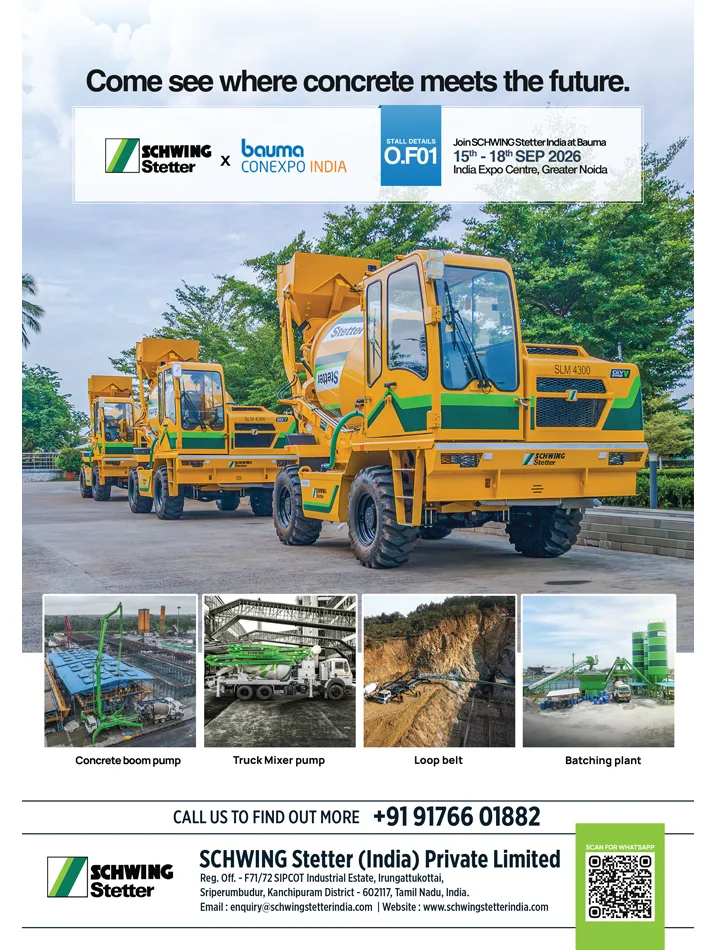
SCHWING Stetter India marked a significant milestone in contributing to the Nation’s 2070 net-zero goal by introducing the sustainability focused products featuring Sludge Pump, C&D waste crushers, RA (concrete recycling plant), FBP 29 (Truck Mixer Pump), Rubble master and AWT 36 Articulating water tower showcasing the company’s dedication in delivering High performance environmentally conscious equipment.

Commenting on the eco-friendly and sustainability products, V.G. Sakthikumar, Chairman & Managing Director, SCHWING Stetter India, “It is estimated that concrete waste generated in India could range up to 750 million tons annually, with the introduction of our advanced C&D waste crushers & Concrete Recycling plants, recycling operations could be performed with a very high efficiency. We believe that recycled concrete can be effectively utilized on-site for structural concreting needs. Our FBP will be a gamechanger, especially designed to cater to the retail ready mix concrete requirements. FBP is Innovated ideally for the ready-mix industry and Road infrastructure construction projects.” FBP – Truck Mixer Pump is a revolutionary addition to its product portfolio. This machine seamlessly combines concrete transport, mixing, and delivery while significantly reducing carbon emissions footprint, addressing the critical demands of modern construction sites across India.
Komatsu Smart Construction and Autonomous Vehicles: Komatsu has been advancing its Smart Construction initiative, which integrates various technologies, including autonomous vehicles and drones, to enhance construction site operations. Their autonomous haulage systems (AHS) are designed to move materials efficiently around large sites without human operators. These systems are deployed in mining and large-scale construction operations. Komatsu also focuses on creating connected ecosystems using IoT technology, allowing for data sharing between machines and enabling predictive maintenance.
Liebherr Hydrogen-Powered Equipment: Liebherr, a leading player in the construction equipment industry, is exploring hydrogen as an alternative fuel source. They have developed prototypes of hydrogen-powered construction machines, including excavators and cranes, to reduce CO2 emissions and improve sustainability. The company has been collaborating with various partners to develop hydrogen fuel cells for use in large construction machines, and they aim to make these machines commercially viable in the coming years.
Hitachi Advanced Excavators with AI: Hitachi is integrating AI and machine learning into its excavators to improve the excavation process. Their technology can recognize soil conditions and adjust the machine’s settings to optimize performance. They are also focusing on fuel-efficient models and integrating hybrid technologies to reduce fuel consumption and emissions.
Talking about the Indian market, Tata Hitachi recently showcases its impressive lineup of products. For instance, ZAXIS 38U, the Mighty Mini compact excavator is designed for urban and tight-space operations, ensuring efficiency and versatility. NX 80 is a robust and fuel-efficient excavator for urban construction requirements. EX 215LC Prime is a powerhouse of performance and reliability, built for a wide range of heavy-duty applications. SHINRAI Prime CEV V (new launch) is the latest iteration of the iconic backhoe loader, offering superior performance and compliance with CEV-5 standards.
According to Mukul Dixit, the industry is on the cusp of transformative trends that promise to redefine its future:
Integration of technology: There is a surge in the use of advanced technologies such as telematics, machine learning, AI, 5G, 3D printing in heavy machinery operations to enable remote operations, health monitoring, improve efficiency, safety and productivity.
Electrification: Many manufacturers are investing in electric-powered earthmoving equipment which is more energy-efficient, produces fewer emissions and has lower operating costs than traditional diesel-powered equipment. The use of electric-powered excavators, wheel loaders, and bulldozers is expected to increase in the coming years.
Autonomous and semi-autonomous machines: Earthmoving equipment with autonomous and semi-autonomous capabilities is becoming increasingly popular in the industry. These machines are equipped with advanced sensors, cameras, and control systems, enabling them to operate autonomously or with minimal human intervention.
Advanced materials: The use of advanced materials, such as high-strength steel and lightweight composites, is becoming more prevalent in earthmoving equipment. These materials can improve equipment durability, reduce weight, and increase fuel efficiency.
What lies ahead for Real Estate!
According to Colliers India, infrastructure augmentation and policy-level push have enabled the Indian real estate to sail through multiple ebbs and flows of property cycles. Throughout the last few decades, key regulatory frameworks and acts such as the RERA Act, PMAY, and REIT Regulations have provided a boost to investor and end-user participation. Policies and regulations for Logistics and Data Centers have been instrumental in the accelerated growth of newer real estate frontiers. Furthermore, flagship programmes such as the Golden Quadrilateral Project, PM Gati Shakti Master Plan, ‘Make in India’ Programme and National Infrastructure Pipeline have positively impacted multiple real estate segments across the country, particularly the industrial & warehousing segment. With high-volume freight movement along industrial corridors, we can anticipate amplified requirement for warehouses, logistics hubs, and manufacturing units across multiple smaller locations in the country.
Alternate investments to become mainstream
Over the years, driven by strong domestic growth prospects, improvements in ease of doing business, and continual FDI relaxations, foreign capital inflow has grown significantly across diverse sectors. Institutional investments in the real estate sector in the last decade has crossed USD 60 billion, with majority being funded by foreign players. The anticipated spurt in foreign capital and equally strong contribution from domestic investors will fast-track the adoption of alternate funding strategies in Indian real estate. Green financing in the form of bonds & credit issuances and relatively newer financing avenues such as social-impact, distressed, special situation, and venture capital funds will become more prevalent in the next few years.
Digitalization & Sustainability will be the central themes in the future of real estate
Over the next few years, the Indian real estate sector will increasingly embrace digitalization across aspects ranging from planning, design & construction to property & facilities management. PropTech and Metaverse are likely to mature and elevate Indian real estate to global standards of operational efficiency, transparency and accountability. Increased data consumption, growing internet penetration, rise of online services, digitalization of businesses, and stricter adherence to data localization regulations are expected to spur demand for co-location and edge data centers closer to demand hubs.
Advanced technologies will also play a major role in decarbonizing the real estate sector. With focus on built spaces, developers will incorporate sustainable elements at every stage of construction. Green-certifications in the office market will particularly become a hygiene-factor and green-adoption levels are likely to increase from about 60-70% to almost 100% over the next few years.
Fast Facts
- Continuing the momentum from previous years, the Modi 3.0 Government reaffirmed its infrastructure-centric growth strategy with an emphasis on Public-Private Partnership (PPP) projects and asset monetization.
- Each infrastructure-related ministry will develop a 3-year pipeline of projects for implementation in PPP mode. States will also be encouraged to do the same and can seek support from the India Infrastructure Project Development Fund (IIPDF) scheme to prepare PPP proposals.
- An outlay of Rs.1.5 lakh crore (US$ 17.30 billion) is proposed for the 50-year interest-free loans to states for capital expenditure and incentives for reforms.
- Building on the success of the first Asset Monetization Plan announced in 2021, the second plan for 2025-30 will be launched, aiming to reinvest Rs.10 lakh crore (US$ 115.34 billion) in new projects. Regulatory and fiscal measures will be adjusted to support the plan.
- The budgetary allocation to Ministry of Railways for FY26 has been pegged at Rs.255,445 as against Rs.255,393 in FY25. The roads and highways budget saw a 3% increase with an allocation of Rs.287,333 crore for FY26 against Rs.278,000 crore in FY25.