
Mining’s Next Big Shift
From massive machines to intelligent, connected and increasingly sustainable systems, mining equipment is entering a new era—shaped by rising mineral demand, the pursuit of operational resilience and a fundamental shift in the economics of extraction. As the global mining industry responds to resource security, critical-mineral demand, decarbonisation and the need for greater productivity, technology is becoming integral to how mines are designed, equipped and operated. For India, this transition assumes an even greater strategic significance as the country seeks to strengthen its mineral security, expand domestic extraction and build the industrial capabilities needed to support its infrastructure and energy ambitions. Against this backdrop, this cover story examines the forces reshaping mining equipment globally and in India, and the strategic shifts that will define its next phase…… writes, PRERNA SHARMA.
Mining is no longer operating in isolation from the forces reshaping the global economy. Infrastructure expansion, urbanisation, industrial growth and the energy transition are intensifying demand for minerals, while the rise of critical minerals is adding a new dimension to resource security. For mining companies, the equation is becoming more demanding: deliver greater output and reliability while managing costs, safety, energy use and environmental impact.
That is putting mining equipment at the heart of the industry’s transformation. For decades, machinery was judged primarily by horsepower, payload, digging depth, cycle time and durability. Those fundamentals remain critical, but a new set of measures is gaining equal importance—equipment utilisation, uptime, energy efficiency, connectivity, predictive maintenance and lifecycle value.
The machines themselves are evolving. Excavators, haul trucks, drills, loaders and crushers are increasingly becoming connected assets rather than standalone equipment. Sensors and telematics provide real-time visibility into machine health and performance, while analytics can identify emerging faults and optimise utilisation. Automation and autonomous systems are also beginning to transform how equipment is operated, improving consistency while reducing exposure to hazardous environments.
The mine is becoming smarter—and its machines have to become smarter with it. As mechanical engineering converges with data, automation and electrification, the distinction between mining equipment and mining technology is becoming increasingly blurred.
The scale of the opportunity underscores why this transition matters. According to IMARC Group, the global mining equipment market was valued at US$162.9 billion in 2025 and is projected to reach US$237 billion by 2034, expanding at a CAGR of 4.13% between 2026 and 2034. Asia Pacific accounted for 61.9% of the global market in 2025, reflecting the region’s strong mineral base, industrial expansion and infrastructure investment. IMARC identifies rising demand for minerals and metals, technological advances in AI, automation and IoT, the shift towards more energy-efficient equipment and growing sustainability requirements among the key forces shaping the market.
But the opportunity is not simply a function of more mines or larger equipment fleets. The nature of extraction itself is changing. As ore grades decline and deposits become more challenging to access, operators are under pressure to extract greater value from every tonne moved. Equipment must therefore deliver not just capacity, but higher availability, precision and productivity—while controlling fuel, energy and maintenance costs. In a capital-intensive industry, even incremental gains in uptime or utilisation can have a significant impact on mine economics. This is making digitalisation a core operating lever rather than a technology add-on.
Connected equipment can provide a real-time view of fleet health, utilisation and operating conditions, while predictive analytics can identify potential failures before they translate into unplanned downtime. AI is increasingly being applied to areas such as equipment deployment, haulage optimisation, drilling and processing, while automation and autonomous systems can improve consistency and reduce human exposure in hazardous operating environments. Gradually, the mine is evolving from a collection of machines into an integrated ecosystem of equipment, people, data and decisions.
Electrification is adding another dimension to this transformation. Battery-electric and other lower-emission equipment are gaining traction as miners look to reduce fuel consumption and emissions. The opportunity is particularly relevant underground, where reducing diesel use can also lower ventilation requirements and improve working conditions. Increasingly, manufacturers are looking to combine alternative powertrains with automation and digital controls, creating equipment that is not only cleaner but also more productive and responsive.
The result is a convergence of disciplines that is reshaping the equipment industry itself. Mechanical engineering remains the foundation, but it is increasingly being complemented by software, sensors, analytics, automation and energy technologies. A modern haul truck, for instance, can simultaneously function as a production asset, a connected data source, an increasingly autonomous platform and a component of a mine’s energy strategy.
That convergence is also changing what mining companies expect from equipment manufacturers. The purchase decision is moving beyond machine specifications towards total lifecycle value. Reliability and engineering capability remain non-negotiable, but uptime, remote diagnostics, energy efficiency, digital integration, parts availability, maintenance support and operator enablement are becoming increasingly important differentiators.
For OEMs, this is creating a shift from selling equipment to building longer-term technology and service relationships. For miners, it is changing the question from which machine offers the highest capacity? to which equipment ecosystem can deliver the strongest operational and economic outcome over its lifecycle?
That may ultimately prove to be one of the industry’s most consequential shifts: the value of mining equipment will increasingly be determined not by what the machine can do on its own, but by how intelligently it can perform as part of the mine.
India’s Equipment Opportunity
India’s mining equipment opportunity is unfolding against a distinctive backdrop. The country is expanding infrastructure at scale, strengthening domestic resource security and entering a more mineral-intensive phase of industrial growth. Coal and iron ore remain fundamental to the economy, while copper and a widening range of critical minerals are gaining strategic importance as manufacturing, electrification and the energy transition accelerate.
This is creating demand across the mining equipment spectrum—from exploration and drilling to excavation, hauling, crushing, processing and material handling. More significantly, capacity expansion and technology modernisation are increasingly converging, creating a market where productivity, reliability and lifecycle economics matter as much as machine capacity.
According to IMARC Group, India’s mining equipment market was valued at US$6.79 billion in 2025 and is projected to reach US$12 billion by 2034, growing at a CAGR of 5.81% between 2026 and 2034. Accelerating mineral extraction, infrastructure development, government investment in coal and critical-mineral programmes, greater mechanisation and the adoption of automated and digitally connected machinery are among the key growth drivers.
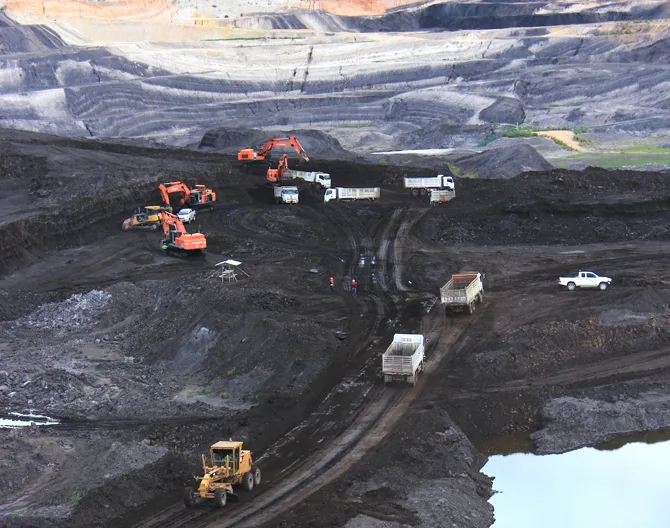
The market’s composition highlights where demand is concentrated. Excavators account for 28.5%, while surface mining represents 49.5%, reflecting the continued dominance of open-cast coal and iron ore operations. Metal mining contributes 47.1% of applications, while East India accounts for 45.7% of the market, reflecting the concentration of mining and metal-production activity across Jharkhand, Odisha and Chhattisgarh.
Yet the opportunity is not simply about adding more equipment. As mines become larger and more complex, asset availability and utilisation are becoming strategic levers. Remote monitoring, telematics, condition-based maintenance and fleet-management systems can help operators reduce downtime, improve deployment and extract greater productivity from existing assets. For large fleets operating for extended hours, even incremental improvements in availability can materially influence mine economics.
The other defining opportunity lies in building the equipment ecosystem within India. Growing domestic demand, localisation priorities and the country’s engineering capabilities are encouraging manufacturers to deepen local production, sourcing, technology partnerships and service networks. The ambition extends beyond import substitution: a stronger domestic ecosystem can improve supply resilience, shorten lead times and build capabilities suited to India’s operating conditions while creating potential for global competitiveness.
The transition is already reaching sophisticated equipment. In January 2025, Gainwell Engineering delivered what IMARC describes as India’s first indigenously manufactured room-and-pillar mining equipment package to Eastern Coalfields, comprising a continuous miner and feeder breaker developed at its Panagarh facility in West Bengal. The development points to India’s growing ability to manufacture advanced mining equipment domestically rather than relying solely on imported technology.
India’s mining equipment story, therefore, is evolving from one of mechanisation to one of capability—combining a growing domestic market with the ambition to build, modernise and increasingly innovate within the equipment ecosystem.
The New Performance Equation
The mining machine is getting bigger, smarter—and increasingly less dependent on the technologies that powered it for decades. Across India’s equipment landscape, 2026 is bringing a new generation of excavators, haul trucks, electric equipment and digitally enabled machines that are redefining what productivity means at the mine site. Payload and power remain fundamental, but they now sit alongside energy efficiency, uptime, connectivity, safety and lifecycle economics as critical measures of machine performance.
JCB is making a decisive move into the higher-capacity excavator segment with the 520X, its largest X Series excavator and a 52–57-tonne class machine. Powered by a 298-kW (400-hp) Cummins X12 engine, it is designed for high-output applications, with a 6.9-metre boom for versatility and a 6.5-metre mass-excavation boom for higher production. Bucket capacities range from 2.8–3.4 cu m, with up to 279 kN dipper tearout and 318 kN bucket tearout force.
The machine also brings a strong digital and efficiency layer to the segment. Powerboost can increase tearout force by up to 6%, while Eco, Power and Lift modes allow performance to be matched to the application. Engine Autostop, Auto Idle and JCB LiveLink support fuel efficiency, emissions reduction and remote monitoring of machine location, fuel use, CO₂ emissions and maintenance. With more than 25,000 hours of destructive testing behind its dig-end, the 520X combines heavy-duty durability with the connectivity and control increasingly expected from next-generation mining equipment.
Volvo Trucks India is addressing the equation from the haulage side. Its FMX Edge, introduced in 2026 for Indian mining operations, features a 31.2-cu-m SAE heap body and 2.8-metre width, enabling it to work with larger excavators and support higher productivity per cycle. Developed and validated for Indian mining conditions, the truck reflects a more integrated approach to equipment design, where the performance of the haul truck is considered in relation to the loading equipment, haul cycle and overall mine productivity.
If JCB and Volvo demonstrate the continuing importance of mechanical capacity, BEML is pushing the equipment equation into a new powertrain era. In April 2026, BEML unveiled India’s first indigenous 35-tonne Electric Dump Truck at its Mysuru Complex. Designed specifically for demanding mining environments, the truck combines a 35-tonne payload and approximately 60-tonne gross vehicle weight with a high-efficiency Permanent Magnet Synchronous Motor. Its electric drivetrain is designed to achieve 85–90% energy efficiency, while regenerative braking recovers energy during operation, particularly on downhill haul cycles. A liquid-cooled battery thermal-management system supports the 300-kWh lithium-ion battery, while charging infrastructure can take the battery from 0 to 80% in approximately 60–90 minutes.
The economics are equally significant. BEML says the platform can deliver up to 60–70% savings in energy costs and 40–60% reduction in overall operating costs, subject to operating conditions, with a potential payback period of approximately one to two years. The machine therefore represents more than another electric vehicle; it is an attempt to make electrification commercially relevant to the demanding duty cycles of mining.
The development also reinforces India’s indigenous engineering story.
BEML’s mining and construction portfolio already spans 35- to 205-tonne dump trucks, excavators, shovels, dozers, loaders and other heavy equipment, while its R&D portfolio includes larger electric dump-truck platforms such as the BH150E and BH205E.
Powering the Next Generation
SANY is taking electrification into another demanding category. In June 2026, Hindustan Zinc deployed India’s first 250-metric-tonne electric crane from SANY at its Zinc Smelter in Debari, Rajasthan. The diesel-electric hybrid all-terrain crane can operate on both electric and diesel power and is expected to avoid approximately 250.8 tonnes of CO₂ equivalent annually, replacing a diesel crane consuming around 93,600 litres of fuel a year.
The deployment is notable because it takes electrification into heavy lifting, where load requirements, duty cycles and reliability create very different engineering challenges from conventional electric construction equipment. SANY’s wider India proposition is following the same trajectory, combining electric excavators and mining equipment with intelligent cranes, advanced piling solutions and digitally enabled machines.
The underlying proposition is changing. Electrification is no longer simply about replacing a diesel engine with a battery. Manufacturers are increasingly designing machines around the specific energy and operating requirements of an application—including charging infrastructure, duty cycle, payload, terrain and utilisation.
Propel Industries is another important Indian example. Its high-capacity 90CED and 70CED electric dump trucks bring battery-electric technology into heavy off-road applications, with high body volumes, rapid charging, advanced safety systems and DGMS compliance. Designed for applications including coal, overburden, limestone and iron ore, the machines underline the growing effort to develop electric equipment around the realities of heavy-duty mining rather than adapting technology developed for lighter applications.
Tata Hitachi is pursuing the same transition through its EX210LC Prime E, a tethered electric excavator that brings electric operation to an established excavator platform. The company’s technology proposition extends beyond the powertrain: ConSite uses machine data and analytics to monitor equipment health, while INSITE provides visibility into utilisation, fuel consumption, location and operating performance.
The combination is important. The future machine is unlikely to be defined by its powertrain alone. Electric propulsion, digital monitoring and predictive maintenance are increasingly becoming interconnected parts of the same equipment proposition.
From Machine to Intelligent Asset
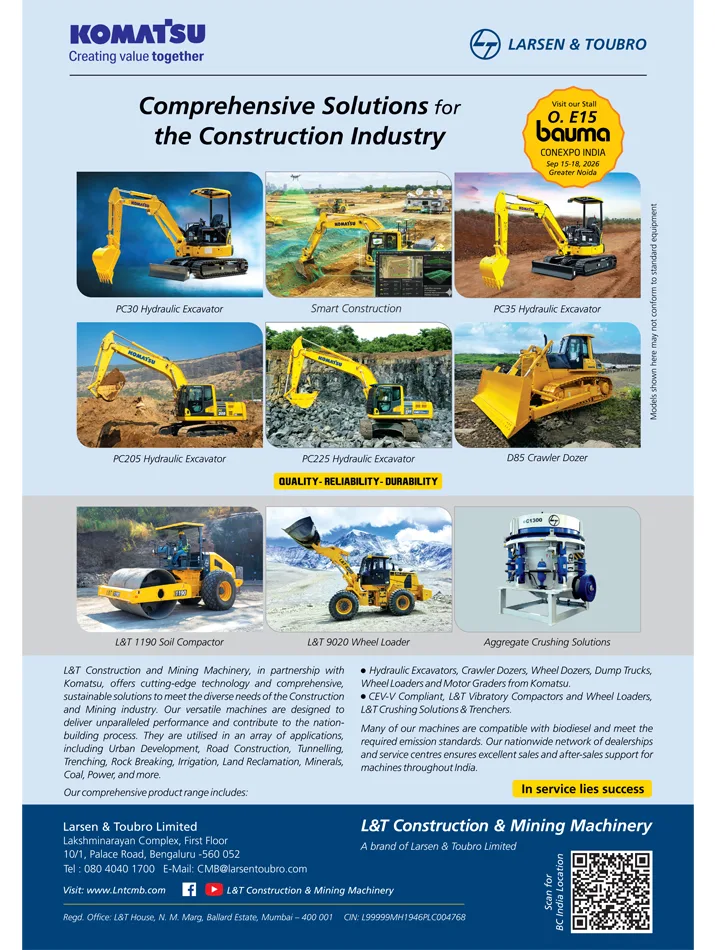
The most consequential change, however, may be taking place inside the systems that surround the machine. At EXCON, L&T Construction & Mining Machinery and Komatsu demonstrated remote operation of a Komatsu hydraulic excavator located more than 7,000 km away in Japan, controlled from Bengaluru through Komatsu’s EarthBrain ecosystem. The system brings together high-speed data transmission, real-time machine feedback, IoT sensors, drone surveys and 3D terrain models.
The significance goes well beyond remote control. It points to an operating model in which data and control can travel beyond the physical boundaries of the mine. In hazardous environments, remote operation can reduce human exposure; across large sites, connected systems can provide visibility over dispersed fleets; and information from machines, terrain and production can support faster operational decisions. Komatsu’s wider digital ecosystem, including KOMTRAX and KOMTRAX Plus, reinforces this movement towards connected fleet management and machine-health monitoring.
Caterpillar is embedding a similar intelligence into the machine itself. Its new Cat 6040 hydraulic mining shovel, introduced globally in March 2026, is a 400-tonne-class machine designed around productivity, fuel efficiency and uptime. Its Hydraulic Optimization system dynamically assigns hydraulic flow and pressure according to the function being performed, making the machine up to 15% more fuel efficient than shovels without the system. Cat Payload helps operators consistently achieve target truck loads, while the redesigned cab improves visibility and operator awareness.
The significance is in the way these features improve the loading cycle itself. More accurate payloads can reduce under-loading and overloading, while hydraulic optimisation can reduce wasted energy. Cat has also built the 6040 around streamlined serviceability and remote diagnostic capabilities, bringing productivity, efficiency and maintenance closer together in one equipment platform.
The intelligence layer is also moving deeper into the powertrain. Cummins has announced a series of 2026 mining developments spanning its QSK60 engine, PrevenTech monitoring platform, hybrid-electric haulage and a new clean-sheet engine platform. The latest QSK60 development is focused on improving total cost of ownership and lifecycle value, while factory-integrated sensors can work with PrevenTech to provide greater visibility into engine health and support more proactive maintenance.
Cummins is also advancing hybrid-electric haulage, with its retrofit system being tested on an ultra-class mining truck at the Caserones copper and molybdenum mine in Chile. The technology captures braking energy and redeploys it during high-demand sections such as climbs, with future commercial solutions targeting significant reductions in fuel use and emissions. A new engine platform is also undergoing field testing for 90–120-tonne haul trucks and 150–220-tonne excavators, showing how powertrain innovation is becoming an important part of the next equipment cycle.
Kobelco brings another dimension to this evolution through application-focused equipment and operator support. Its K-Assist system provides real-time diagnostics, geofencing and fuel monitoring, while its range of specialised configurations and attachments allows machines to be adapted to particular operating requirements. The emphasis reflects a broader shift: equipment is increasingly being developed around how and where it will work, rather than simply around a standard machine specification.
For mining operators, this changes the parameters of equipment value. Productivity, availability, energy consumption, safety and maintainability are becoming interconnected measures, rather than separate considerations. A machine that delivers higher output but consumes significantly more fuel, requires frequent intervention or cannot communicate its operating condition may no longer represent the strongest proposition.
Engineered for the Mine
The next competitive edge is increasingly application-specific engineering. A machine working in a high-cycle open-cast coal mine faces very different demands from one operating in an iron-ore pit, quarry or underground environment. Payload, ground conditions, haul distances, material characteristics and operating hours all influence the right equipment configuration. This is reflected across the portfolios of HD Hyundai, XCMG and CASE, while Sandvik and Epiroc are taking specialised equipment deeper into underground and automated mining. Wirtgen adds another dimension through surface-mining and material-processing technologies.
Across these portfolios, the emphasis is shifting from a standard machine to equipment configured around the material, application and operating environment.
That shift is also changing the OEM–customer relationship. Buyers are increasingly looking beyond purchase price and headline specifications to availability, energy consumption, maintenance support, spare-parts access and total cost of ownership. For manufacturers, the opportunity therefore extends beyond the initial sale to lifecycle services, performance monitoring, parts and equipment support.
India’s mining fleet will continue to depend on excavators, dump trucks, dozers, drills, crushers and loaders. But the capability embedded within them is changing rapidly. Mechanical strength is being complemented by smarter controls, specialised configurations, alternative powertrains and increasingly sophisticated support systems. The machine is no longer simply selected for the mine. It is increasingly engineered around it.
The Opportunity Ahead
The next decade could redefine the mining equipment industry on several fronts at once. Mineral demand is rising, deposits are becoming more challenging to exploit, existing fleets require replacement and upgrading, and the economics of every tonne extracted are coming under greater scrutiny. At the same time, decarbonisation, automation, safety and supply-chain resilience are moving from long-term ambitions to operational priorities.
For India, the opportunity is particularly significant. The country needs to expand mineral production while strengthening domestic capability in mining equipment, technology and critical supply chains. That creates room not only for higher volumes of conventional machinery, but for locally engineered electric equipment, connected fleets, automated systems and specialised machines designed around Indian operating conditions.
For equipment manufacturers, this creates both opportunity and pressure. The winners will not necessarily be those that simply build the biggest machine. Increasingly, they will be the companies capable of combining robust engineering with digital intelligence, automation, energy efficiency, application-specific design and dependable lifecycle support. Competitive advantage will increasingly come from solving the operator’s complete productivity equation rather than selling a machine against a specification sheet.
For mining companies, the question is equally fundamental: how can equipment become a strategic enabler of productivity rather than simply a means of moving material?
That is the shift now underway. From the world’s largest surface mines to India’s rapidly evolving mineral landscape, mining equipment is moving beyond mechanical muscle. The machines remain massive, powerful and indispensable—but increasingly, their value lies in their ability to sense, connect, analyse, optimise and operate with greater precision. The future of mining will still depend on machines that can move mountains. Increasingly, it will depend on machines that can think while they do it.
Fast Facts
- $162.9 billion — The global mining equipment market was valued at this level in 2025 and is projected to reach US$237 billion by 2034, growing at a 4.13% CAGR.
- 61.9% — Asia Pacific’s share of the global mining equipment market in 2025, making it the industry’s dominant regional market.
- $6.79 billion à $12 billion — India’s mining equipment market is projected to grow from its 2025 value to $12 billion by 2034, representing a 5.81% CAGR.
- 28.5% — Excavators’ share of India’s mining equipment market in 2025, making them the largest equipment type.
- 49.5% — Share of surface mining equipment in India’s market in 2025, reflecting the country’s continued dependence on large-scale open-pit coal and iron-ore operations.
- 45.7% — East India’s share of India’s mining equipment market, driven by the concentration of coal reserves, iron ore and steel-producing clusters across Jharkhand, Odisha and Chhattisgarh.