
Trucks & Tippers – From Haulers to Heroes
Trucks and tippers are at the forefront of an unfolding transformation in construction and mining. Once seen as basic workhorses, they are now strategic enablers of productivity, safety, and sustainability. High-strength materials, advanced hydraulics, telematics, electrification, and alternative fuels are redefining fleet efficiency and operational visibility across both segments. In India, a booming infrastructure agenda and fleet modernization are accelerating this evolution, while global markets embrace digital and sustainable construction practices. As regulations tighten and technology reshapes operations, the next decade will see trucks and tippers move from being mere vehicles to indispensable assets driving modern infrastructure delivery…. writes, PRERNA SHARMA.
The global trucking industry is undergoing a structural reset—driven not merely by cyclical demand shifts but by a deep technological, material, and operational reconfiguration. At the centre of this transition stand tipper trucks, now evolving far beyond their traditional role as rugged haulers for construction, quarrying, and mining. Once viewed simply as workhorses, they are emerging as advanced, intelligence-enabled platforms engineered for higher productivity, safety, sustainability, and lifecycle efficiency. As per MRFR analysis, the Tipper Trucks Market Size was estimated at $21.8 Billion in 2024. The Tipper Trucks industry is projected to grow from $22.73 Billion in 2025 to $34.47 Billion by 2035, exhibiting a CAGR of 4.25% during the forecast period 2025 – 2035.
This growth is underpinned by rapid urbanization, infrastructure expansion across emerging economies, and the rising scale of construction, material handling, and industrial earthmoving activities. As smart cities and next-generation mining operations accelerate, tippers form the backbone of aggregates movement, debris clearance, overburden disposal, and ore transport. Fleet operators continue to prioritise high-capacity, durable machines capable of performing reliably in demanding terrains while delivering measurable improvements in total cost of ownership.
The technological envelope surrounding tippers is widening rapidly. Powertrain upgrades, aerodynamic enhancements, and more fuel-efficient engine architectures are improving operational economics. At the same time, the use of high-tensile steels, wear-resistant body designs, lightweight composites, and precision-engineered chassis is enabling higher payloads, reduced body fatigue, and longer service intervals. Smart hydraulic systems—equipped with automated tipping controls, multi-stage cylinders, faster dump cycles, and load-sensing safety valves—are elevating performance efficiency while strengthening operational safety in high-risk environments. Digitalization has become a defining pillar of the modern tipper ecosystem. Advanced telematics platforms now provide real-time insights on payload weight, dump cycles, engine and brake health, idling hours, fuel consumption, and driver behaviour. In mature markets, connected dashboards are already standard, with OEMs offering predictive maintenance, remote diagnostics, and data-driven fleet orchestration tools that significantly improve uptime and asset utilization. As regulatory requirements and on-site safety expectations rise, features such as ADAS, stability monitoring, fatigue tracking, and intelligent braking systems are becoming essential.
Demand patterns also reflect a shift toward more specialized applications. On-road tippers designed for municipal operations, infrastructure contracting, and regulated highway transport are gaining traction, while heavy-duty variants remain dominant in mining and mega-project environments due to their superior durability, high ground clearance, and robust driveline engineering. Across both segments, sustainability is emerging as a strategic priority. Urban construction zones are driving early interest in electric and hybrid tippers, valued for their low noise, zero tailpipe emissions, and compliance advantages, even as cost and charging infrastructure remain barriers to scale.
As the trucking ecosystem adapts to new economic realities, environmental imperatives, and digital-first operating models, tippers are becoming central to the reinvention of material logistics. The next phase of evolution will be characterised by intelligent automation, electrified drivetrains, high-strength lightweight materials, and deeply integrated data platforms—ushering in a new era of safer, smarter, and more productive vehicles built for the future of construction and mining.
Market Segmentation – Vehicle Type
In the Tipper Trucks Market, rigid trucks continue to lead due to their stability, robustness, and high payload capacity, making them ideal for heavy-duty construction and mining operations. They are preferred for their reliability, simpler maintenance, and cost-effectiveness. Articulated trucks, however, are emerging as the fastest-growing segment, driven by demand for maneuverability, flexibility on tight job sites, and urban operations. Technological advancements, lighter vehicle designs, and eco-friendly innovations are further accelerating their adoption. Dump trailers remain relevant for specialized applications but account for a smaller overall market share. The evolving dynamic between rigid and articulated trucks reflects the balance between traditional power and innovative design, catering to diverse operational needs.
Market Segmentation – Payload Type
The Tipper Trucks Market spans a wide range of payload capacities. The 20–30 tons segment holds the largest share, favored for heavy-duty construction and mining due to its robustness, efficiency, and compliance with regulatory standards. Meanwhile, the below 10 tons segment is gaining momentum, particularly in urban logistics and smaller construction projects, where fuel efficiency, cost-effectiveness, and maneuverability are critical. This shift highlights growing demand for diverse payload solutions to match evolving infrastructure, urbanization, and sustainability requirements, with businesses increasingly seeking lighter, eco-friendly trucks alongside high-capacity models.
Market Segmentation – Axle Configuration
The market features multiple axle configurations, including 4×2, 4×4, 6×4, 6×6, and 8×4. The 6×4 configuration dominates, offering a balanced combination of load capacity and operational stability, making it the preferred choice for construction and mining. The 4×4 segment is the fastest-growing, prized for superior traction and off-road capabilities, ideal for challenging terrain. Meanwhile, the 8×4 configuration, though less common, is gaining traction due to exceptional load-bearing capacity and stability, catering to niche high-capacity requirements. The diversity in axle configurations allows fleet operators to match vehicles precisely to operational demands, optimizing performance across project types and environments.
India’s Infrastructure Boom Places Tippers at the Industry’s Core
India represents one of the world’s most dynamic tipper markets, fuelled by massive road expansion, housing growth, metro rail corridors, river-linking programmes, industrial corridors, and a renewed thrust in mining. Few global economies are scaling infrastructure at India’s current pace, and this acceleration is directly reflected in the heavy-duty trucking segment. Industry estimates indicate that the India Tipper Truck Market, valued at $2.47 billion in 2025, is projected to reach $4.05 billion by 2031, registering a robust CAGR of 8.55% during the forecast period.
The strongest evidence of this expansion comes from SIAM’s FY 2024–25 data. India recorded 9.57 lakh commercial vehicle sales, with 3.74 lakh units in the Medium & Heavy Commercial Vehicle (M&HCV) segment, where tippers form a significant share. Despite fluctuations in commodity cycles and regional demand, M&HCVs have demonstrated resilience, underscoring the indispensable role of tippers in national and state-level infrastructure projects.
As contractors increasingly take on larger, multi-location, and time-sensitive projects, demand has surged for high-tonnage, durable, and fuel-efficient tippers. The market is gravitating toward premium configurations, including 48-tonne and above multi-axle tippers, extended wheelbase variants, sleeper cabins for multi-shift operations, and precision-engineered drivelines capable of withstanding demanding gradients and loaded return cycles. Rising economic activity in Tier-II and Tier-III hubs has further accelerated adoption of higher-spec vehicles built for continuous, high-frequency operations.
Segment Highlights:
Flatbeds and Reefers: In India, flatbeds command a 41.66% market share, serving as the backbone for transporting steel, timber, machinery, and containers. Standardized integration with 20-ft and 40-ft container twist-locks enables seamless intermodal transfers across road, rail, and port networks, reinforcing their dominance in industrial logistics. In contrast, refrigerated (reefer) bodies are expanding at 8.03% annually, driven by pharmaceuticals, processed food, and cold-chain-dependent FMCG segments operating at 2–8 °C. Rapid dairy throughput from hubs in Maharashtra and Gujarat has further increased demand, prompting operators to adopt back-haul matchmaking platforms to reduce empty-trip inefficiencies. Leading body-builder clusters in Jamshedpur and Pune are integrating composite insulation panels and solar-powered gensets, broadening cost-efficient and energy-aware options.
Tipper Fleet Upgrades and Operational Efficiency: The tipper fleet is witnessing its most significant upgrades in two decades. With the average age of India’s M&HCV population nearing ten years, replacement demand has surged across highways, district roads, mining clusters, and urban transit projects. Manufacturers are introducing high-strength steel bodies, reinforced cross-members, abrasion-resistant tailgates, and HYVA-style rapid hydraulic systems to shorten tipping cycles and minimise downtime. Application-specific designs—rock bodies for mining, box tippers for aggregates, municipal tippers with compaction units, and modular bulker-to-tipper formats—enable contractors to maximise fleet versatility.
Digital tools are increasingly standard in tipper operations. GPS tracking, geo-fencing, payload monitoring, fleet dashboards, and predictive maintenance, once confined to long-haul logistics, now underpin operational efficiency for construction fleets. IoT sensors help prevent pilferage, monitor load compliance, and automate site-to-site billing. India’s evolving digital payments ecosystem, FASTag-based analytics, and app-driven fleet management are raising benchmarks for productivity and accountability.
Hydraulic Safety, Alternative Fuels, and Policy Support: Advanced hydraulic safety and stability systems form a core pillar of India’s tipper evolution. Modern trucks feature tilt-angle monitoring, auto shut-off on uneven terrain, cabin-mounted hydraulic diagnostics, and upgraded PTO mechanisms that reduce driveline stress. These innovations are essential in India’s variable working environments—from steep mining inclines to soft-soil construction sites and unpaved rural roads. Parallel experimentation with LNG-powered and battery-electric tippers marks the early stages of alternative-fuel adoption in short-haul urban operations. While mainstream uptake is constrained by charging infrastructure and initial costs, supportive measures—scrappage incentives, stricter BS-VI compliance, state-level green mobility initiatives, and GST efficiencies—are expected to accelerate the transition.
Strategic Implications: This period is pivotal due to the convergence of technological progress, regulatory support, and large-scale infrastructure deployment. As India aligns global benchmarks in safety, productivity, hydraulics, and fleet intelligence to local conditions, fleet owners embracing connected, high-payload, stability-optimized, and alternatively powered tippers are poised to gain lower cost-per-tonne-kilometre, higher asset utilization, and seamless compliance. Over the next decade, India’s tipper market will be defined by advanced materials, cleaner powertrains, high-efficiency tipping mechanisms, and unprecedented operational visibility. The modern tipper is no longer a simple haulage unit; it is emerging as a sophisticated productivity asset central to India’s infrastructure ambitions.
New-Generation Tippers Making a Beeline for India’s Infrastructure Push
India’s infrastructure and mining roadmap through 2030 will require far more capable, reliable, and digitally connected tipper fleets. The shift toward automation, predictive maintenance, data-led fleet optimisation, and safety-first operations is already underway and set to accelerate. While electric and hybrid tippers remain in early stages of experimentation, they represent the next frontier as India aligns with decarbonisation goals and cleaner construction norms. Globally, tippers are also moving toward intelligent design—high-efficiency drivetrains, advanced driver-assist systems, lighter-yet-stronger materials, and sustainable powertrains suited for regulated zones.
This global innovation cycle is influencing the latest round of 2024–25 tipper launches in India, with OEMs unveiling stronger chassis, faster hydraulic systems, connected cabins, and alternative-fuel-ready platforms. This section highlights flagship 2025 launches and the technology advancements they bring to India’s evolving trucking ecosystem.
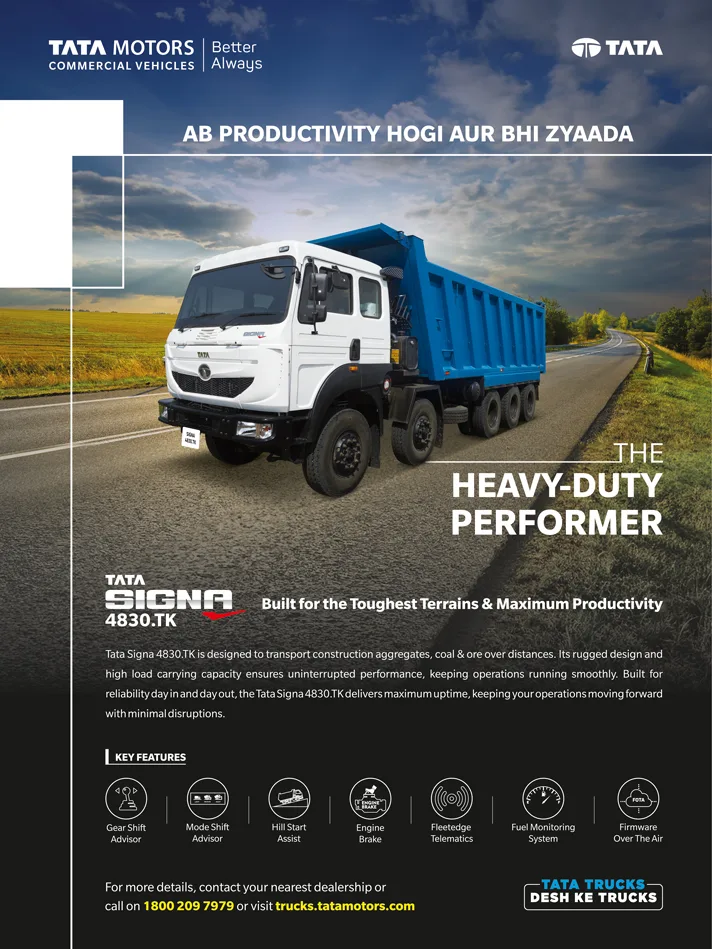
September 2025 marked a notable shift in India’s intermediate and light commercial vehicle landscape with Tata Motors unveiling the Tata LPT 812, a significant addition to the ILMCV segment. Positioned as India’s first 4-tyre truck with a 5-tonne rated payload and equipped with factory-fitted air-conditioning, the LPT 812 is designed for urban efficiency and enhanced operating comfort. This launch reinforces Tata Motors’ broader strategy of strengthening its diversified tipper and truck portfolio across the SFC, LPT, Ultra, Signa, and Prima platforms.

Rajesh Kaul, Vice President & Business Head – Trucks, Tata Motors Commercial Vehicles, highlights how the company’s Construck range for heavy-duty mining continues to lead with robust engineering, high-strength drivetrains, and advanced features such as Hill Start Assist, Engine Braking, ATC, vertical exhausts, and comprehensive driver monitoring systems. The connected ecosystem is further cemented by Fleet Edge, supporting over 8.25 lakh vehicles and providing real-time operational intelligence to fleet managers. Tata Motors also pushed the envelope on sustainable trucking with the LNG-powered Prima G.35K and the battery-electric Prima E.28K, along with the introduction of the Prima 35.K Auto Shift at the Bharat Mobility Expo 2025—powered by the new 8.5L Cummins engine built for deep mining environments.
July 2025 saw Eicher Trucks and Buses elevate the light and medium-duty segment with its next-generation Pro Plus Series launched in Pithampur. Rooted in the highly successful Pro Series platform, the enhanced range offers higher payload capacity, extended cargo options, factory-installed AC, and complete digital connectivity integration through MyEicher and Eicher Live. The lineup spans a wide spectrum of applications—from long-haul and e-commerce to intra-city logistics—through models such as the 3018XP Plus with a 2.1m sleeper cabin, the agile 2118XP Plus for intercity movement, the versatile 2059 Plus for city logistics, the highly configurable 2095XP Plus, and the compact 2049 Plus for last-mile needs. The 2110XPT Plus tipper, engineered with a rugged ET60 gearbox and hybrid gearshift, caters to building and construction demands with improved comfort, connectivity, and drivability. The company underscores new levels of productivity through intelligent air conditioning, real-time diagnostics, and driver-centric cabin design, setting a refreshed benchmark for India’s LMD trucking segment.

Dr. Venkat Srinivas, Business Head – Truck and Bus & Construction Equipment, Mahindra & Mahindra Ltd., spotlighted the BLAZO X m-DURA tipper series as a transformative step in India’s tipper engineering landscape. Available in 28T and 35T GVW configurations with 22 cum, 16 cum, and 14 cum rock bodies, the m-DURA range is designed for endurance, uptime, and application-specific ruggedness. Mahindra’s Double Service Guarantee—delivering a 36-hour turnaround time and 48-hour uptime—coupled with round-the-clock onsite support for fleets of up to 10 tippers, strengthens its value proposition. Integrated with Mahindra IMAXX’s advanced telematics suite, the m-DURA range is positioned not merely as a truck series but as a complete operational ecosystem built for modern transport challenges.
In February 2025, Blue Energy Motors Ltd. accelerated the transition toward clean freight movement by signing an MoU with the Maharashtra Government to invest Rs 3,500 crore for manufacturing 30,000 electric trucks by 2025–26. With plans to establish a facility supporting R&D, battery pack manufacturing, motor production, and large-scale charging infrastructure, the initiative is set to enhance the state’s EV ecosystem and create over 4,000 jobs.
Complementing this rise of electric mobility.

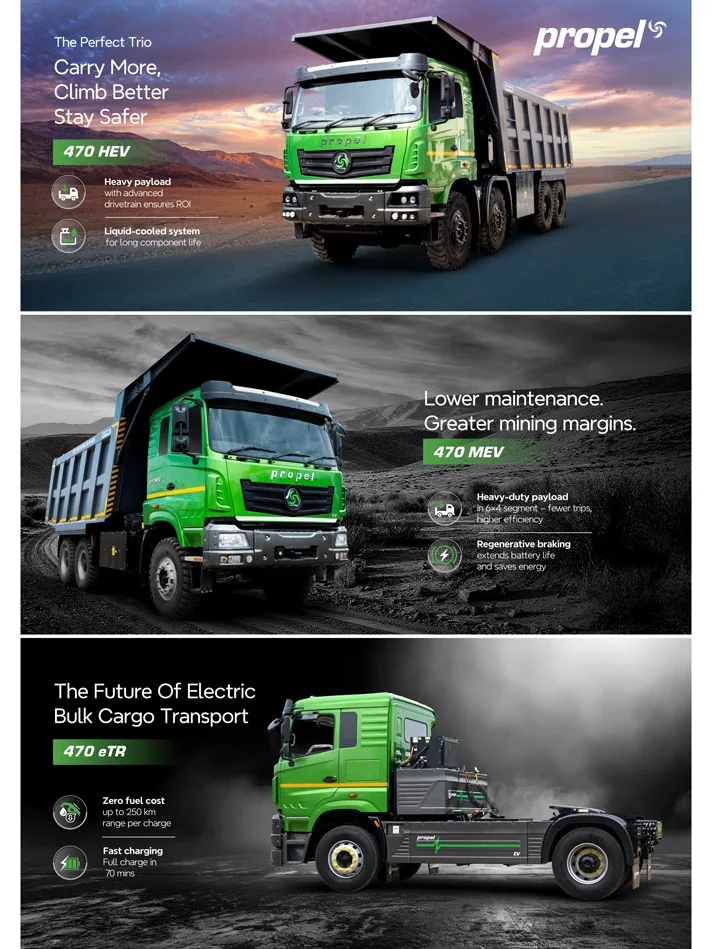
Propel Industries unveiled the 4×2 EV Tractor Trailer Truck – the 470 eTR. Featuring high-capacity lithium-ion battery packs with up to 350 km range and fast-charging ability that reaches 100% in 70 minutes (for the 385 kWh pack), the 470 eTR is engineered for heavy haulage with a powerful 350 kW motor delivering 2600 Nm of torque. “This launch marks a momentous stride in EV innovation and excellence at Propel Industries. More than 1,20,000 cumulative hours went into testing of the powertrain and other critical components,” said Senthil Kumar, Managing Director. Siddharth Kirtane, President – E.V. Business, expanded on its mining-focused

EV ecosystem: “Our aim is to tap the rigid dump truck and heavy-duty truck segment,” noting the company’s earlier success with its 45-ton and 60-ton GVW mining tippers. The 470 eTR also incorporates advanced safety systems—ABS, EBS, ESC, HSA, and traction control—alongside telematics and IoT solutions for real-time monitoring, energy optimization, and fleet intelligence.
As regulatory transitions reshape the commercial vehicle sector, Ashok Leyland has proactively aligned its manufacturing ecosystem to meet the upcoming mandate for air-conditioned cabins across all medium and heavy commercial vehicles by October 2025. “Currently, all our factories are producing AC cap vehicles,” said

Sanjeev Kumar, President and Head of M&HCV, Ashok Leyland. The company’s readiness, supported by early adoption of AC cabins in tippers and mining trucks, positions it comfortably ahead of the compliance curve. Kumar observed that the industry is well-placed to absorb the 1–1.5% expected price increase, with financing institutions already adjusting their models. He added that Ashok Leyland is going beyond regulatory requirements by integrating performance AC and HVAC systems, especially suited for extreme climatic regions. Reflecting on market performance, Kumar acknowledged a mild 3% degrowth in FY25 but projected lower single-digit growth for FY26, driven by government capex, rising steel and cement demand, and strong recovery in the bus segment. “The first two months of FY26 have already shown promising volume trends,” he noted, further strengthened by the RBI’s recent interest rate cuts, which are expected to enhance buying sentiment.
Further advancing sustainable heavy freight mobility, Adani Enterprises launched India’s first hydrogen fuel cell truck in May 2025. Developed in collaboration with Indian and international technology partners, the hydrogen-powered truck features three hydrogen tanks, smart operating systems, and the ability to carry up to 40 tonnes of cargo over a 200-km range. Flagged off in Raipur by Chhattisgarh Chief Minister Vishnu Deo Sai, the truck will initially transport coal from the Gare Pelma III Block to a state power plant. “The launch of

India’s first hydrogen-powered truck reflects the state’s commitment to sustainability,” he said. Dr. Vinay Prakash, CEO – Natural Resources and Director, Adani Enterprises, added, “The initiative for hydrogen-powered trucks is a significant step towards Adani Group’s commitment to decarbonization and responsible mining.” By integrating autonomous dozer push technologies, solar energy, digital mine management tools, and tree transplanters, the company aims to shape future-ready, low-emission mining ecosystems.
Strategic Signals for Senior Leaders and Fleet Decision-Makers
The global tipper ecosystem is undergoing a decisive technology transition, driven by electrification, digitalisation, and advanced safety intelligence—capabilities that are increasingly integrated into mainstream platforms rather than remaining premium add-ons. Modern tippers now deliver deeper environmental compliance, enhanced operational visibility, and reduced downtime through connected diagnostics and real-time performance data. Strategic alliances between OEMs, tier-one suppliers, and technology integrators are accelerating the deployment of autonomous-ready functions, reshaping safety benchmarks across regulated construction and mining environments.
Material innovation continues to be a key differentiator. Lightweight, high-strength chassis and body structures improve payload efficiency and lifecycle economics, offering fleets the dual advantages of lower fuel consumption and higher utilisation. OEMs are also strengthening supply chain agility—through reshoring, nearshoring, and expanded local vendor ecosystems—to mitigate market volatility, leverage government incentives, and maintain tighter cost control.
The aftermarket is emerging as another decisive frontier. Customised duty-cycle configurations, predictive maintenance analytics, and modular platform architectures allow manufacturers to enhance uptime and reduce total cost of ownership. Regional dynamics differ: North America and Europe prioritize decarbonisation and digital fleet orchestration, MEA and Africa focus on rugged durability, and Asia-Pacific pursues rapid technology adoption in line with infrastructure growth. India, however, sits at the intersection of these trends. Rising construction intensity, stricter safety regulations, and a preference for connected, high-strength, fuel-efficient tippers are accelerating the adoption of global innovations, positioning the country as both a proving ground and launchpad for next-generation tipper platforms.
The Future of Tipper Trucking: Intelligent, Rugged, Indispensable
The coming decade of trucking will be defined by how efficiently nations build and modernize core infrastructure—and at the center of this transformation are tippers. In India, where infrastructure ambitions are scaling rapidly, and across global markets embracing digital and sustainable construction, tippers are evolving from simple haulers into strategic assets that enhance productivity, cost efficiency, and operational sophistication. No longer just vehicles, modern tippers serve as enablers of national development, indispensable tools for contractors, and central links in the construction and mining ecosystem.
The global tipper market is at a pivotal juncture, shaped by regulatory shifts, technological disruption, and evolving procurement priorities.
Organizations that realign portfolios, deepen technology partnerships, and recalibrate supply chains to respond to these forces will be best positioned to capture sustained growth and build long-term competitive advantage. The road ahead promises unprecedented advancement, scale, and innovation, cementing tippers as the linchpin of modern infrastructure delivery—both in India and worldwide.
Fast Facts
- The Tipper Trucks Market Size was estimated at $21.8 Billion in 2024. The Tipper Trucks industry is projected to grow from $22.73 Billion in 2025 to $34.47 Billion by 2035, exhibiting a CAGR of 4.25% during the forecast period 2025 – 2035.
- The demand for customized and specialized tipper trucks is on the rise, reflecting the diverse needs of various industries.
- The Rigid vehicle type segment is anticipated to reach a valuation of $13.68 Billion by 2035.
- The 10-20 tons payload capacity segment was valued at 7.0 USD Billion in 2024 and is expected to grow to $10.5 Billion by 2035.
- The 6×4 axle configuration segment is expected to grow from $6 USD Billion in 2024 to $9 Billion by 2035.