
MOTOR GRADERS – Beyond the Blade
Motor graders have long been regarded as the finishing machines of the construction industry, but their role has expanded far beyond surface levelling. As infrastructure projects become larger, more complex and increasingly quality-driven, precision grading has emerged as a critical factor influencing structural durability, project timelines and lifecycle costs. Today’s graders combine advanced hydraulics with digital machine control, automation, telematics and intelligent fleet connectivity, enabling contractors to achieve unprecedented levels of accuracy and productivity. Backed by sustained investments in highways, airports, mining, industrial corridors and urban infrastructure, the market is entering a new phase where technology is becoming as important as mechanical capability…….. writes, PRERNA SHARMA.
Every world-class infrastructure asset begins with precision below the surface. Whether it is an expressway, airport runway or mining haul road, the quality, durability and performance of the finished asset are fundamentally shaped by the accuracy of grading. Long before pavement is laid, the motor grader establishes the geometry that influences drainage, ride quality and structural longevity.
Once regarded primarily as a finishing machine, the motor grader has evolved into a strategic productivity asset. As infrastructure projects become larger, technically more demanding and increasingly outcome-driven, grading has emerged as a critical engineering function rather than a routine construction activity. Today’s machines combine precision hydraulics with digital grade control, telematics and intelligent automation, enabling contractors to deliver greater accuracy, higher productivity and lower lifecycle costs. This transformation reflects a broader shift in infrastructure priorities. The focus is no longer just on building faster, but on building infrastructure that performs better over decades. Consequently, contractors are evaluating graders not merely by horsepower or blade capacity, but by their ability to enhance precision, reduce rework, improve machine utilization and integrate seamlessly into connected construction ecosystems. For OEMs, this has accelerated innovation beyond mechanical performance towards intelligent, data-driven grading solutions.
Global Market: Precision Becomes the New Growth Driver
While motor graders account for a relatively niche segment of the global construction equipment industry, their strategic significance is expanding as infrastructure projects increasingly prioritize quality, precision and lifecycle performance. The global motor grader market is estimated at USD 4.62 billion in 2026 and is projected to reach USD 7.82 billion by 2034, growing at a 6.8% CAGR, driven by sustained investments in transportation infrastructure, mining, airports and urban development. Asia-Pacific is expected to remain the fastest-growing regional market, while North America continues to lead the adoption of premium, technology-intensive graders.
The market’s evolution is being shaped less by construction volumes and more by the complexity of modern infrastructure. Demand is shifting towards machines capable of delivering higher grading accuracy, lower operating costs and greater productivity across large-scale projects. Consequently, OEMs are increasingly differentiating their offerings through intelligent blade control, connected fleet management, predictive maintenance, electro-hydraulic systems and operator-assist technologies rather than conventional performance parameters such as horsepower alone.
Mining has emerged as another high-growth application, fuelled by rising investments in coal, iron ore and critical minerals. Well-maintained haul roads can significantly improve truck speeds, reduce tyre wear and lower fuel consumption, making motor graders indispensable to mine productivity and operating efficiency.
Equally important is the growing emphasis on sustainability. Contractors are demanding machines that combine cleaner engines, fuel-efficient hydraulics, optimized idle management and longer service intervals to reduce both operating costs and carbon emissions. As digital construction becomes mainstream, motor graders are evolving into connected productivity platforms—where precision, machine intelligence and lifecycle value increasingly define competitive advantage.
India: Entering the Next Phase of Growth
According to industry estimates, the Indian motor grader market is expected to grow at a 5.6% CAGR during 2025–2031, with annual sales projected to increase from about 1,200 units in 2023 to nearly 1,350 units by 2029. The 151–250 HP category currently dominates the market, reflecting strong demand from highway construction, mining and large infrastructure projects.
The opportunity is being fuelled by India’s massive infrastructure pipeline. The country today has over 6.7 million km of roads, the world’s second-largest road network, while National Highways account for only around 2% of the network but carry nearly 40% of total traffic. The length of four-lane and above National Highways has more than doubled over the past decade to nearly 48,000 km, creating sustained demand for precision grading equipment capable of delivering superior pavement quality and drainage. Beyond highways, programmes such as PM Gati Shakti, airport expansion, industrial corridors and increasing mining activity are further widening the application base for motor graders.
The market is also witnessing a gradual shift towards technology-led procurement. Contractors are increasingly prioritising fuel efficiency, grading accuracy, machine uptime and total cost of ownership over upfront acquisition costs. This is accelerating the adoption of graders equipped with GNSS machine guidance, telematics and automated blade control, enabling faster project execution with fewer operating passes and reduced rework. As India’s infrastructure ambitions evolve from building scale to building quality, the motor grader is steadily transitioning from a support machine to a strategic asset that underpins the delivery of durable, high-performance infrastructure.
Innovation Beyond the Blade
The evolution of the motor grader is no longer being defined by horsepower or blade dimensions alone. As infrastructure projects become larger, more complex and increasingly quality-driven, manufacturers are reimagining graders as intelligent productivity machines that combine precision engineering with digital capabilities, improved operator ergonomics and lower lifecycle costs. The focus has shifted from moving more material to achieving greater grading accuracy, reducing rework and enhancing machine utilization.
Caterpillar has raised the bar for the grader segment with the global launch of its Next Generation Cat 150 and Cat 160 Motor Graders, representing one of the industry’s most significant product introductions this year. Developed around the themes of precision, productivity and operator efficiency, the new platform features a redesigned operator station, enhanced visibility, intuitive controls, integrated Cat Grade technologies and improved machine connectivity, enabling contractors to achieve greater grading consistency with lower operating effort. While these next-generation models have debuted in global markets, Caterpillar continues to serve the Indian market through its established portfolio, including the 120 GC, 140 Next Gen, 140 LVR and 160 LVR, reflecting the company’s continued focus on bringing advanced grading capabilities to the country’s expanding infrastructure and mining sectors.
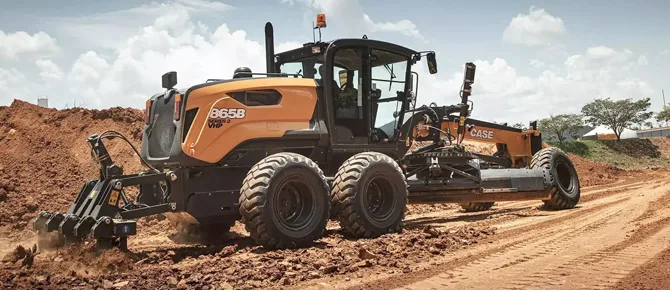
CASE Construction Equipment has strengthened its premium grader portfolio with the introduction of the GR935 Motor Grader, designed for large-scale road construction and mining applications. Equipped with a high-output FPT engine and electro-hydraulic controls, the machine offers faster blade response, improved grading consistency and enhanced hydraulic efficiency. Combined with a redesigned operator environment and easier service access, the GR935 reflects the industry’s growing emphasis on productivity, operator comfort and lower operating costs.
Rather than introducing an entirely new machine, John Deere continues to advance its digital construction ecosystem through SmartGrade. Factory-integrated machine control enables operators to work directly from digital terrain models, improving grading accuracy while reducing survey work, material waste and rework. Together with JDLink telematics and Connected Support, the system provides contractors with real-time insights into machine health, utilization and maintenance, enabling more efficient fleet management.
Komatsu has adopted a similar approach by strengthening the digital capabilities of its GD Series graders. Through its Komtrax telematics platform, contractors can remotely monitor fuel consumption, idle time, machine location and service schedules, while refinements in hydraulic performance and operator controls contribute to greater grading efficiency. The company’s strategy underscores the growing importance of connected equipment in improving productivity throughout the machine lifecycle.
As India’s only major indigenous manufacturer in the segment, BEML continues to play a pivotal role in supporting the country’s infrastructure and mining sectors. The company offers motor graders tailored for road construction, mining and defence applications, with an increasing focus on localization, operator comfort and higher-capacity machines. Its ongoing development of a 550 HP mining grader reflects the growing demand for specialized equipment capable of supporting large-scale mining operations while reinforcing India’s drive towards self-reliance in heavy construction equipment.
Meanwhile, LiuGong India is expanding its presence through a new generation of CEV Stage V-compliant motor graders that combine cleaner powertrains with improved hydraulic efficiency, onboard diagnostics and enhanced operator comfort. By balancing emission compliance with productivity and competitive ownership costs, the company is strengthening its position in India’s evolving grader market.
Collectively, these developments illustrate how innovation in the motor grader segment is becoming increasingly focused on precision, digital integration, sustainability and lifecycle performance. While each manufacturer has adopted a distinct strategy, the common objective is clear—to equip contractors with machines capable of delivering superior grading accuracy, higher productivity and greater operational efficiency across an expanding range of infrastructure applications.
The Next Wave of Innovation
With intelligent grading systems becoming increasingly mainstream, the next phase of innovation will focus on how motor graders interact with the broader construction ecosystem rather than on standalone machine capabilities. OEMs are developing platforms that seamlessly connect with digital project models, drone-generated terrain data and fleet management systems, enabling grading operations to become an integral part of connected jobsite workflows.
Another defining trend is the growing use of data to improve equipment performance throughout its lifecycle. Rather than relying on scheduled maintenance, contractors are increasingly leveraging real-time machine diagnostics, predictive analytics and remote fleet monitoring to maximize uptime, improve fuel efficiency and optimize asset utilization. As these capabilities mature, the value proposition of a motor grader will extend well beyond grading performance to encompass productivity, serviceability and lifecycle economics. Looking ahead, advances in machine intelligence, vision-assisted operation and scalable automation are expected to further reduce operator dependency while improving grading consistency and safety. The future motor grader will not necessarily be a bigger or more powerful machine—it will be a smarter one, designed to deliver greater precision, operational insight and long-term value across increasingly complex infrastructure projects.
The Road Ahead is Precision-Driven
The motor grader has always played a pivotal role in infrastructure development, but its contribution is becoming increasingly strategic. As governments and developers place greater emphasis on quality, durability and lifecycle performance, grading is evolving from a routine construction activity into a critical engineering discipline. This shift is reshaping both technology and procurement. Manufacturers are designing graders that combine precision engineering with intelligent systems, while contractors are investing in machines that deliver measurable gains in productivity, fuel efficiency and machine availability. Competitive advantage is no longer defined by engine output alone, but by the ability to build faster, more accurately and with greater operational certainty.
For India, the opportunity extends well beyond expanding road networks. With airports, industrial corridors, mining, logistics infrastructure and renewable energy projects gathering pace, demand for high-performance grading solutions is set to broaden significantly. As the infrastructure sector enters a quality-led era, the motor grader is steadily moving from the margins of construction to the centre of project execution—helping shape infrastructure that is not only built to last but built right from the ground up.
By the Numbers
- The global motor grader market is estimated to be valued at USD 4.62 billion in 2026 and is projected to reach USD 7.82 billion by 2034, expanding at a CAGR of 6.8% over the forecast period.
- The 151–250 HP segment continues to dominate global demand, offering the optimal balance of power, versatility and operating efficiency for road construction, mining and infrastructure projects.
- In India, the motor grader market is expected to register a 5.6% CAGR between 2025 and 2031, supported by continued investments in highways, mining, industrial corridors and airport infrastructure.
- Industry estimates indicate that annual motor grader sales in India are expected to increase from around 1,200 units in 2023 to nearly 1,350 units by 2029, reflecting steady demand from both infrastructure and mining sectors.
- Manufacturers are increasingly differentiating their products through digital capabilities, fuel efficiency, operator comfort and lifecycle support, signalling a shift from conventional equipment competition towards intelligent productivity solutions.
Did You Know?
- A motor grader’s blade can typically rotate 360 degrees and assume multiple cutting angles, allowing a single machine to perform grading, ditching, slope cutting, scarifying and road maintenance operations.
- Modern motor graders are capable of achieving centimetre-level grading accuracy when equipped with integrated machine control systems, significantly reducing rework and material wastage.
- Beyond highways, motor graders are increasingly deployed in mining haul roads, airport runways, renewable energy parks, rail corridors and defence infrastructure, making them one of the most versatile machines in the earthmoving fleet.