
Every machine we sell anywhere in the world is designed and built at Fara Vicentino in Italy, at a single site, and exported to more than 150 countries.
MB CRUSHER provides the widest range of attachments capable of making construction sites of any size, independent and competitive regardless of the job’s nature and scope of action. The company has evolved over the years and has become the benchmark for the construction equipment industry around the world today. In an exclusive interview to CONSTRUCTION OPPORTUNITIES, GUIDO AZZOLIN, CHIEF EXECUTIVE OFFICER, MB CRUSHER INDIA PVT. LTD. — SUBSIDIARY OF MB S.P.A., FARA VICENTINO, ITALY, details on his company’s products showcased at BAUMA CONEXPO INDIA, after-sales support, new launches and a lot more.
Give us a brief background of your company and the products offered. Detail the technology developed by your company, and the benefits accrued to your end user.
Start with a contractor on a rural road contract. He has granular sub-base in his bill of quantities, an excavator on site, and stone lying inside his own alignment. What he lacks is a way of turning one into the other. So he buys aggregate from a crusher site a hundred kilometres away, pays for the material and again for the trucking, and lets somebody else’s dispatch schedule govern his programme.
We patented the first jaw crusher bucket for excavators in 2001. Everything is designed and manufactured at Fara Vicentino in Italy, and the range now runs from crusher buckets through screening buckets, shaft screeners, drum cutters, sorting grapples and, most recently, demolition pulverizers.
The attachment carries no engine, no chassis and no second operator. It runs off the carrier’s existing hydraulic circuit, and the attachment is engineered to protect the carrier rather than stress it, so the excavator works within its normal operating range.
What the customer takes from that is not a machine. It is material that no longer has to move.
What are the USPs of your products vis-à-vis competitors? What is your company’s focus on R&D and technological innovation?
I would rather describe what the machine is than what other machines are not. A crusher bucket is a jaw crusher first and a bucket second. That distinction matters, because the failure mode in this category is a bucket with jaws bolted into it: the structure flexes, the jaw gap wanders, and output size stops being repeatable by the third month.
Ours is built the other way round. The body and structural frame are built so that the crushing chamber holds its geometry under load. The jaw plates are designed to keep their edge over time and can be turned rather than replaced, and a blockage clears without emptying the bucket by hand. Output size is set on site to match the material.
Research and development sits in the same building as production at Fara Vicentino. It means a design change and the machine it affects are twenty metres apart, and that something observed on a site in India can be tested against the same steel that will be cut for the next batch.
After-sales service as a strategic differentiator.
It is the differentiator, and that is true of any attachment in this category.
A crusher bucket is a wear machine, deliberately built so that the components taking the punishment are the components you replace: jaw plates, chamber liners, hydraulic seals. The consequence is that purchase price is not really the decision. What matters is whether the wear items are there when the machine needs them, and whether the cost of running it over several years can be budgeted at the start rather than discovered along the way.
What matters to us is how many days in the year the machine could actually work, not how quickly someone shows up after it stops. The question is not how quickly somebody arrives after a breakdown, but how many days in the year the machine could not work. Wear here is predictable and published to the customer, and a contractor who knows those intervals plans around them instead of reacting to them.
What I would resist is the idea that service begins once the invoice is settled. A machine that stops on a rural project two hundred kilometres from anywhere does not cost a repair. It stops the project. That is the cost we are managing, and the one contractors here ask about first.
Detail the new products launched at bauma CONEXPO INDIA.
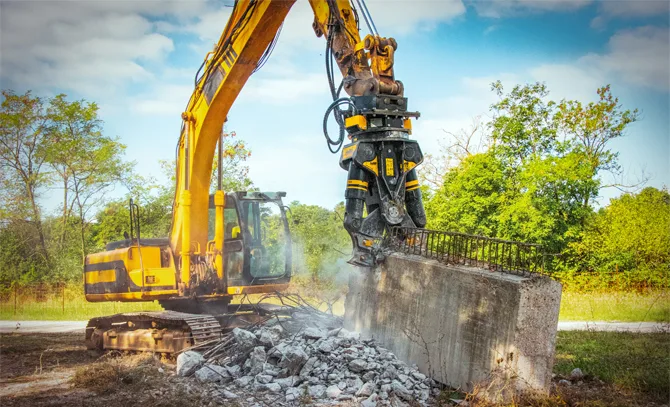
We were on stand O.D15, and the machine we have brought to India for the first time is the MB-PT1650 demolition pulverizer.
It is MB’s first move into primary demolition rather than the processing that follows it. The PT series offers 360-degree continuous hydraulic rotation, so the operator presents the jaw at the angle the structure requires instead of repositioning the carrier. Three jaw kits are interchangeable on the same body: crushing for primary work, pulverizing for reducing what is left, and a shear kit for cutting reinforcement. No booster is needed. Warranty is 24 months.
A demolition contractor who already runs an MB attachment owns the second half of the process. Bring the structure down, then crush the debris into usable aggregate on the same slab, with the same carrier and operator.
Alongside it we showcased the BF90.3 with a live demonstration, together with the BF60.1, the MB-L160, the R900 drum cutter and the S-18 screening bucket. The demonstration was the point of the stand. Nobody here has been convinced by a static machine under lights.
Do you practise ‘Make in India and Sell Globally’ — using your India manufacturing base to supply the global market?
No, and I would rather answer that plainly than leave room for inference. MB has no manufacturing base in India. Every machine we sell anywhere in the world is designed and built at Fara Vicentino in Italy, at a single site, and exported to more than 150 countries.
That is a deliberate decision, not an omission. This is a wear product working under high cyclical load, and The variables determining whether a crushing chamber holds its geometry over years of heavy use are metallurgical and dimensional, and they are unforgiving of variation. Keeping design, testing and production inside one building means a change to any of those is verified against the machine itself rather than communicated down a supply chain and hoped for.
What is in India is the part that has to be: the company itself, present since 2013, with coverage across the country, and more than a decade of field data from Indian material feeding back into what gets built in Italy.
Localisation is a fair question. My answer is that we localise the parts of this business that benefit from being local, and we do not localise the part that does not.
What is your outlook for the components industry and your company going forward?
The carrier is becoming the platform, and the attachment is becoming the thing that decides what the carrier is for. The question moves from how many machines do I need on this site to how many functions can I get from the machine I already have.
Two pressures push the same way. Sites are more constrained than they were: urban work with neighbours on three sides, tunnel and slope work with no room for a plant, sites where material has to be dealt with where it lies. And skilled operators are not abundant. Equipment that needs one man and one carrier rather than four men and three machines is not a convenience there. It is the only arrangement that can be staffed. The environmental argument arrives at the same place by a different route, which is why I do not treat it as a separate agenda.
For our own part, the work ahead is unglamorous. Keep the machines available and the wear parts moving. Keep testing on the material contractors here actually feed them.
Keep explaining a category that still surprises people the first time they watch it work. This market rewards patience and punishes noise.